
Is Custom Cabinetry Worth the Extra Investment?
Table of Contents
- Custom vs Stock Kitchen Cabinets: What the Extra Money Actually Buys
- Average Cost of Custom Kitchen Cabinets and How Pricing Works
- Kitchen Renovation Return on Investment: What Cabinetry Contributes
- Design Flexibility and Personalized Layouts With Custom Specifications
- Longevity, Maintenance, and Repairability Over Time
- Environmental Impact and Sustainability in Custom Cabinetry
- Decision Matrix: Matching Cabinetry to Room Type and Stay Duration
- Frequently Asked Questions
Last Updated: September 28, 2026
Custom vs Stock Kitchen Cabinets: What the Extra Money Actually Buys
The question of whether custom cabinetry is worth the extra investment comes down to three things: how long you plan to stay, how unusual your kitchen layout is, and how much you care about the details you touch every day. Mario Laflamme Contracting & Renovation Ltd walks homeowners through this decision on nearly every kitchen remodel, and the honest answer is that custom cabinets pay off for some households and quietly waste money for others.
Here is the part most guides skip: the gap between stock and custom is not one jump, it is three tiers. Stock cabinets come in fixed widths, usually in standardized increments, which means filler strips and dead corners. Semi-custom units adjust in smaller increments and offer a wider finish range, while fully bespoke cabinetry is built to your exact wall dimensions and design.
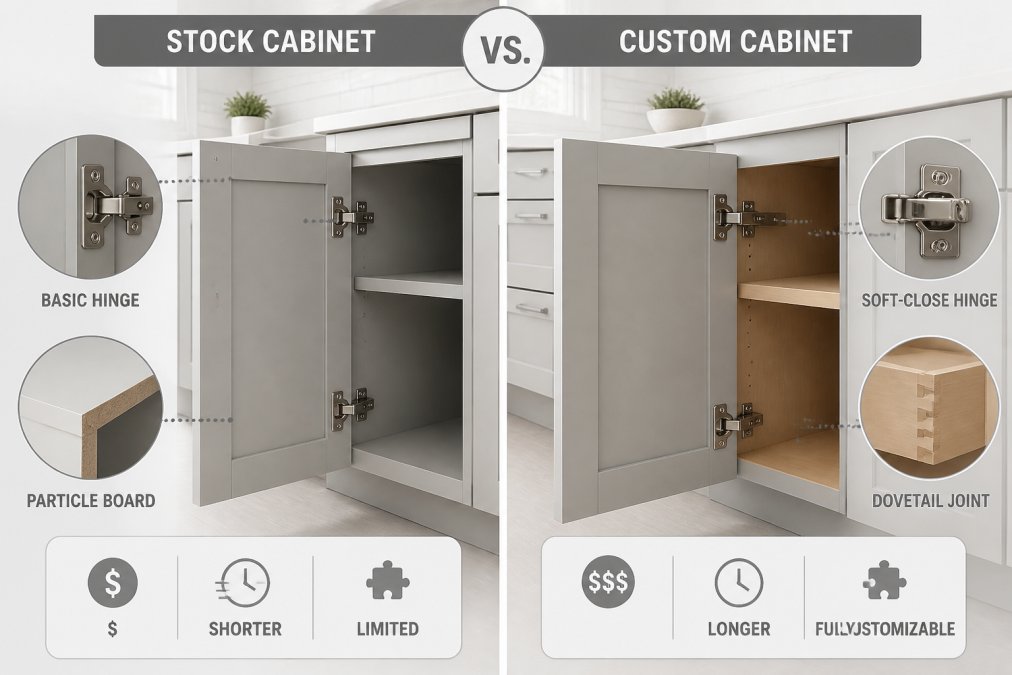
Cabinet Box Construction and Material Quality
The cabinet box is where money is either spent or saved, and it is the part you never see. Stock cabinets often use particle board with a veneer skin. It holds up fine in dry conditions but swells if a dishwasher leak goes unnoticed. Custom and semi-custom boxes typically use plywood construction, which resists moisture and holds screws far better over a 20-year lifespan.
Dovetail joints on drawer boxes are the other tell. A dovetail drawer box is a drawer assembled with interlocking wedge-shaped joints cut into the sides, which resist pulling apart under daily load. Stapled or glued joints are faster to build and cheaper to buy, and they are usually the first thing to fail on a budget cabinet.
Finish Quality and Hardware Differences
Finish quality separates a cabinet that looks new for 15 years from one that looks tired in five. Factory finishes on stock cabinets are durable, but color options are limited and touch-ups are difficult because the coating is applied in a controlled plant. Custom cabinetry is finished to your specification, which means a wider palette and easier field repairs, though the quality depends entirely on the shop doing the work.
Hardware matters just as much. Soft-close hinges and full-extension drawer glides are standard on most custom builds and optional upgrades on stock. A common mistake is spending on door style while cheaping out on hinges. Hinges fail first, and replacing them means matching an obsolete model.
Average Cost of Custom Kitchen Cabinets and How Pricing Works
There is no single average cost of custom kitchen cabinets, because cabinetry is priced per linear foot and the range is wide. Semi-custom work generally sits in the middle of the market, while fully bespoke cabinetry sits at the top, and both are quoted per linear foot of cabinet run rather than per box.
Pricing depends on material choice, door style, finish, hardware, and the complexity of the layout. A straight run of base cabinets costs far less per foot than an L-shaped layout with a corner pantry, appliance panels, and a custom range hood surround. Any quote you receive should break those elements out separately, and you should ask for that breakdown in writing.
The most expensive mistake in cabinetry is ordering boxes before the appliances are chosen. A fridge that arrives 2 cm wider than the opening means rebuilding the surround, and that change order lands on your invoice.
Kitchen Renovation Return on Investment: What Cabinetry Contributes
Kitchen renovation return on investment is real but rarely dollar-for-dollar, and cabinetry is the single largest line item in most kitchen budgets. Buyers notice cabinet quality immediately, and a kitchen with solid boxes, working drawers, and clean finishes reads as a maintained home rather than a flipped one.
Here is the framework most guides skip: cabinetry ROI is not a fixed percentage, it is a function of three variables you can actually estimate before you commit.
Variable 1: Your home’s value relative to your neighborhood ceiling. If your home is already at or near the top of your street’s price band, bespoke cabinetry rarely returns its full cost at resale because buyers in that bracket expect the kitchen to be finished, not upgraded. If your home sits below the neighborhood ceiling, a quality kitchen can help close the gap. A common pattern is that cabinetry spend should stay under roughly 15 to 20 percent of your home’s current market value for a full kitchen, though this shifts with local market conditions.
Variable 2: Your intended stay duration. The math changes completely depending on how long you hold the home. If you sell in three years, you are competing against other listings on price and photos, and stock or semi-custom cabinets photograph nearly identically to custom at that distance. If you stay ten years, the annual cost of ownership drops sharply, and the durability advantage of plywood boxes and dovetail drawers starts paying you back in avoided repairs and replacements.
Variable 3: The condition of the rest of the home. Cabinetry cannot carry a renovation on its own. If the flooring, lighting, and countertops are dated, premium cabinets will look out of place and buyers will discount the whole room. The cabinetry investment only reads as value when the surrounding finishes are at a comparable level.
A practical way to run the numbers: take your total cabinetry quote, divide it by the number of years you expect to stay, and compare that annual figure against what you would spend replacing budget cabinets once or twice over the same period. Most homeowners find the gap narrows considerably over a ten-year horizon, and that is before factoring in the daily experience of using drawers that still glide properly in year eight.
Cabinetry ROI is not a single number, it is a calculation based on your home’s position in its price band, your stay duration, and the condition of surrounding finishes. Run all three before deciding.
Design Flexibility and Personalized Layouts With Custom Specifications
Custom specifications exist to solve problems stock sizes cannot. Awkward corners, sloped ceilings, radiator covers, and narrow galley kitchens all force compromises with modular boxes, and those compromises show up as wasted space and filler panels.
Storage solutions are where the design flexibility pays off in daily use.
Ask your designer to draw the cabinet layout around your tallest appliance and your most-used counter task first, then fill the remaining space. Most layouts are drawn wall-to-wall, which buries the important decisions until the end.
Longevity, Maintenance, and Repairability Over Time
Cabinetry lifespan depends far more on construction than on price tag. Plywood boxes with dovetail drawers commonly run 20 to 30 years with normal use, while particle board boxes in a humid kitchen often show swelling and sagging much sooner.
Environmental Impact and Sustainability in Custom Cabinetry
Sustainability in cabinetry comes down to material sourcing and how long the product stays out of a landfill. Custom shops can work with certified sustainable lumber, low-emission finishes, and reclaimed material when a client asks, which is difficult to specify with mass-produced lines.
Decision Matrix: Matching Cabinetry to Room Type and Stay Duration
The right tier depends on the room, how long you plan to keep the home, and how the space is actually used. Most guides treat cabinetry as a single decision, but a kitchen, a bathroom, and a home office each have different tolerances for compromise. Use this matrix as a starting point, then adjust for your layout.
| Situation | Recommended Tier | Why |
|---|---|---|
| Short stay, standard layout, tight budget | Stock | Lowest upfront cost, fast install |
| Long stay, standard layout | Semi-custom | Better sizing and finishes without full bespoke pricing |
| Awkward layout or sloped ceilings | Custom | Only tier that fits the space properly |
| Luxury or forever home | Custom | Highest finish quality and resale appeal |
| Rental or quick flip | Stock or refacing | Protects margin, minimal disruption |
| Aging-in-place or accessibility needs | Custom | Drawer heights and clearances built to the user |
Frequently Asked Questions
Are custom cabinets worth the money for resale value?
It depends on your home’s market tier and how long you plan to stay. Custom cabinetry adds the most resale value in higher-priced homes where buyers expect quality finishes and personalized layouts. In more modest homes, semi-custom or refacing may deliver similar returns for less upfront cost. Before committing, ask a local renovation professional to assess your home’s value and what buyers in your area expect.
What are the primary differences between custom and semi-custom cabinetry?
Custom cabinets are built to exact room dimensions, allowing any size, shape, and finish. Semi-custom options adjust stock sizes by small increments, typically around one inch, and offer a wider finish selection than stock but within manufacturer templates. Semi-custom balances personalization with cost-efficiency, making it a practical middle ground for standard kitchen layouts.
How long does it take to install custom cabinets?
Custom cabinetry involves a design and fabrication phase that typically takes several weeks before installation begins. Installation itself usually takes a few days, but the full timeline depends on project scope, material availability, and coordination with countertops, plumbing, and electrical work. A professional contractor can provide a realistic schedule after reviewing your kitchen layout and design choices.
Does custom cabinetry improve kitchen functionality?
Yes. Custom cabinets maximize storage by fitting around existing pipes, ducts, and irregular walls that stock sizes cannot accommodate. You can specify drawer depths, pull-out shelves, and dedicated slots for appliances. This space optimization reduces wasted areas and makes daily cooking more efficient. For older homes with unusual layouts, the functional gain is often the strongest argument for going custom.
What materials are used in high-end custom cabinetry?
High-end custom cabinets typically use plywood construction for the cabinet box, solid wood for face frames and doors, and dovetail joints for drawer boxes. Soft-close hinges and full-extension glides are standard. Finishes range from painted lacquer to stained veneer. These materials cost more upfront but resist warping and wear better than particle board alternatives, extending the cabinetry lifespan significantly.
Table of Contents
Kitchen Island vs Peninsula: Comparison at a GlanceWhat Is a Kitchen Island?Pros and Cons of Kitchen IslandsWhat Is a Kitchen…
Table of Contents
1. What Are Your Project Goals and Vision?2. What Is Your Realistic Budget and How Will You Finance It?3. Home Renovation Planning…