
How to Insulate Basement Ducts to Stop Condensation
Last Updated: November 4, 2026
Quick Summary
To stop condensation, seal every duct seam with mastic and foil tape, then insulate basement ducts with a wrap whose vapor barrier faces the warm, humid side. Insulation alone may not stop sweating, so measure basement humidity and consider a dehumidifier if it stays high.
- Seal all joints and seams with mastic or foil tape before adding any insulation.
- Place the vapor barrier on the warm, humid side, usually the outer face toward the room.
- Do not compress insulation around hangers or elbows, since that lowers its R-value.
- Use a dehumidifier when the ducts sweat mainly on humid days or the basement stays damp.
- Have old insulation, mold inside ducts or possible asbestos assessed before you start wrapping.
Table of Contents
- Why Your Basement Ducts Are Sweating
- Humidity Control Versus Insulation: Which Fixes the Problem
- Basement Duct Insulation Types and How to Choose
- How to Seal Ductwork Before You Insulate
- Step-by-Step: How to Insulate Basement Ducts
- Duct Insulation Installation Tools and Materials
- Safety Hazards, Common Mistakes and When to Call a Professional
- Booking Your Basement Duct Assessment
- Frequently Asked Questions
Why Your Basement Ducts Are Sweating
If your basement ducts are dripping or leaving wet rings on the floor, you are not alone, and insulating basement ducts is often the fix once the cause is clear. Condensation on ductwork is one of the most common problems in older homes. Insulating basement ducts to prevent condensation is often the fix, but only when you understand why the moisture forms in the first place.
Warm, humid air meets a cold metal surface, and water droplets form. Sweating ducts can lead to damp insulation, rust and musty smells. Here is what to look for.
Dew point and humidity in unconditioned basements
Basements stay cool all year, especially in winter. The dew point is the temperature at which air can no longer hold its moisture. When a duct surface drops below that point, water appears on it.
Basements often have relative humidity well above what the home needs. Moist air from laundry, showers and the ground seeps in. Every metal duct that runs through this space becomes a cold spot. The result is condensation that repeats every season.
When the problem is mechanical, not thermal
Insulation does not always solve the problem. Leaks in the duct joints can pull humid air into the system. Poor airflow can also cool the metal enough to cause sweating. Check the seams, look for loose connections and confirm the system is balanced before you spend money on wrap.
Humidity Control Versus Insulation: Which Fixes the Problem
Insulation stops the surface of the duct from getting cold enough to sweat. Humidity control removes the moisture that causes the sweating in the first place. Many homeowners need both.
A dehumidifier in the basement lowers the moisture in the air. Keeping relative humidity at a moderate level usually reduces condensation. If the duct is sweating only on humid summer days, a dehumidifier may solve it alone.
Choose insulation when the ducts are cold all year and the air is not extremely humid. Choose humidity control when the basement is damp and the ducts are fine otherwise. Use both when the ducts run through a wet, unfinished space.
Basement Duct Insulation Types and How to Choose
Most basement ducts use one of three insulation families, but the right choice depends less on the product name and more on the duct material, the basement’s humidity pattern, and whether you plan to open the duct later for cleaning or repair.
- Fiberglass duct wrap (unfaced or foil-faced): Affordable and widely stocked. Works on round and rectangular galvanized steel. Unfaced versions rely on a separate vapor barrier; foil-faced versions combine insulation and barrier in one layer.
- Foil-faced fiberglass sleeves: Pre-sized tubes that slide over round pipe. The foil facing is the vapor barrier, so every seam and butt joint must be taped or the barrier is broken.
- Closed-cell foam (sheet or sleeve): Higher R-value per inch and a built-in vapor barrier. It resists moisture uptake better than fiberglass, which matters in damp unfinished basements. It costs more and is less forgiving to cut around hangers and elbows.
Check the product label for the rated R-value at the thickness you are buying, because the same nominal product line can be sold in several thicknesses.
Material compatibility guide: fiberglass, foam and foil-faced wraps
The failures in this job usually come from mismatched materials, not from bad insulation. Use this as a decision framework.
Galvanized steel, rigid duct. Foil-faced fiberglass wrap or closed-cell foam sheet both work. Seal seams with mastic first, then wrap.
Flexible duct (flex). Use a pre-sized sleeve or a wrap rated for flex, and avoid compressing the inner liner.
Foil-faced wraps. The foil is the vapor barrier, so seams must be sealed with a foil-rated tape, not mastic alone. Foil can peel if the surface was dusty or if the tape was applied cold.
Closed-cell foam. Use an adhesive the foam manufacturer lists as compatible. Some solvent-based construction adhesives attack foam over time, and the bond fails silently behind the wrap.
Adhesives and tapes in general. Mastic is the most reliable seal on metal seams. Watch out: mixing a solvent adhesive with foam, or taping a dusty foil surface, produces a bond that looks fine on installation day and separates within a season. Learn how to soundproof basement ductwork effectively if noise or vibration remains a concern after insulating.
When the duct material is unknown. Older homes sometimes have transite or other cementitious duct sections, or ductboard that has been painted over.
The three main insulation families differ in cost, moisture resistance and how easily they are cut around fittings.
| Insulation type | Best for | Key difference |
|---|---|---|
| Fiberglass duct wrap | Round and rectangular galvanized steel | Affordable; needs separate vapor barrier if unfaced |
| Foil-faced fiberglass sleeves | Round pipe | Foil facing acts as vapor barrier; seams must be taped |
| Closed-cell foam | Damp unfinished basements | Higher R-value per inch; resists moisture; costs more |
How to Seal Ductwork Before You Insulate
Sealing comes first. Insulation on a leaking duct traps moisture and makes the problem worse.
Use mastic sealant or foil tape on every joint and seam. Brush mastic thickly over seams, then press foil tape firmly on top. Check each connection with your hand while the blower runs. Any air movement means a leak.
Step-by-Step: How to Insulate Basement Ducts
Set aside a weekend for this job. Work with the system off.
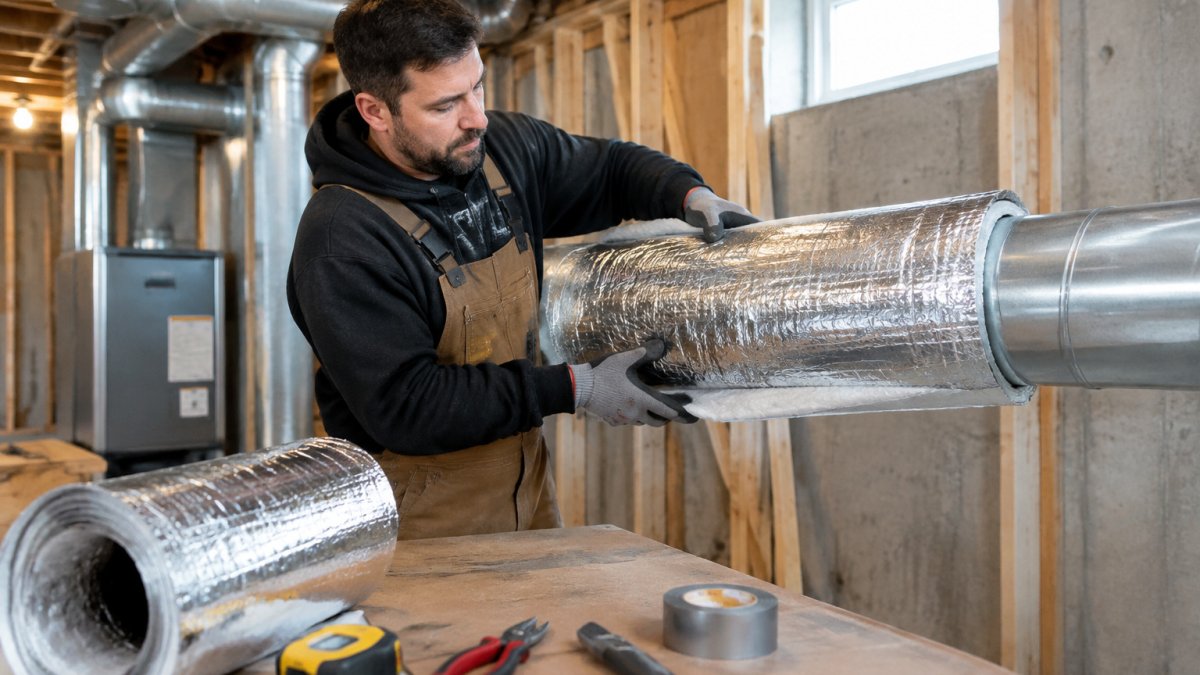
- Measure the ducts. Record the diameter or width and height, and the total length.
- Clean the surface. Wipe away dust and oil so the adhesive sticks.
- Seal the seams. Apply mastic and foil tape as described above.
- Cut the insulation. Cut sleeves about 5 cm longer than each section.
- Wrap the duct. Start at one end and overlap the seams. Keep the vapor barrier on the warm side.
- Secure the wrap. Tape every seam and fasten the edges so they stay flat.
- Check your work. Look for gaps, crushed insulation and exposed metal.
Expect the job to take most of a day for a small basement and longer for a large one.
Vapor barrier placement and why it matters
The vapor barrier must face the warm, humid side of the insulation. In most basements, that means the outer side, facing the room. A barrier on the wrong side traps moisture inside the wrap, where you cannot see it. Check the product instructions before you start.
Duct Insulation Installation Tools and Materials
Gather these before you start:
- Foil-faced duct wrap or closed-cell foam sleeves
- Mastic sealant and a brush
- Foil tape rated for ductwork
- Utility knife and straight edge
- Measuring tape and marker
- Work gloves and a dust mask
- Staple gun or zip ties for fastening
Safety Hazards, Common Mistakes and When to Call a Professional
Most guides treat this as a glove-and-mask job. The bigger risks are what you find before you wrap: old insulation, mold inside the duct, and contaminated surfaces that insulation will trap rather than fix.
Health and safety hazards before you wrap
Old fiberglass. Fiberglass installed decades ago may be degraded, friable, or contaminated with dust and rodent debris. Disturbing it releases fibers into the air. Wear gloves, long sleeves, eye protection, and a respirator rated for particulates, and bag the removed material rather than sweeping it.
Mold inside existing ductwork. Condensation that has been running for seasons can leave mold on the interior of the duct, especially near joints and on the cold side of the metal. Wrapping a moldy duct seals the problem in.
Asbestos and older materials. Homes built or renovated before the mid-1980s can have asbestos-containing materials on or near ductwork, including some older duct wraps and joint compounds. Do not cut, sand, or disturb suspect material. Have it identified before any work begins.
Working conditions. Shut off the furnace and confirm power is off before working near the system. Basement work involves ladders, low clearances, and sharp sheet-metal edges; gloves and eye protection matter as much as the dust mask.
Common mistakes to avoid
- Insulating a leaking duct. Air leaks pull humid air into the wrap, where it condenses out of sight. Seal seams with mastic and foil tape first, then insulate.
- Putting the vapor barrier on the wrong side. The barrier faces the warm, humid side, in most basements, the outer face toward the room. A barrier on the cold side traps moisture inside the wrap.
- Compressing the insulation. Squeezing fiberglass or foam to fit around hangers and elbows lowers its R-value at exactly the spots most likely to sweat.
- Leaving gaps at seams and joints. Every unsealed butt joint is a cold spot and a condensation point.
- Skipping the humidity check. If basement relative humidity stays high, insulation alone may not stop sweating. Measure humidity before and after the job.
- Wrapping flex duct too tightly. Over-compressing the inner liner restricts airflow and can create a new cold spot downstream.
When to call a professional
Call a technician if the ducts are damaged or crushed, if mold is visible inside the ductwork, if the system needs rebalancing, or if you cannot identify older duct or insulation materials. An HVAC technician can test airflow and static pressure, confirm whether the system is balanced, and advise on duct cleaning before insulation. For suspected asbestos, use a qualified abatement contractor rather than a general handyperson.
Booking Your Basement Duct Assessment
Insulation is only one part of a dry, healthy basement. If the ducts are part of a larger basement project, a professional assessment can show what needs attention first. Mario Laflamme Contracting & Renovation Ltd offers renovation services, and you can contact us for a free consultation to discuss your basement project. Explore our basement projects to see how we approach finished basements, or choose the right basement insulation for moisture control before you buy materials. Both steps help prevent condensation from coming back.
Frequently Asked Questions
Why do basement ducts sweat?
Basement ducts sweat when the surface of the metal drops below the dew point of the air around it. Cold supply air moving through an uninsulated duct chills the metal, and warm, humid basement air condenses on contact. Basements are often cooler and damper than the rest of the house, which makes this worse in spring and summer.
Insulating the duct raises the surface temperature above the dew point, so moisture stops forming on it. If the sweating persists after insulation, check for leaks or humidity problems that insulation alone will not fix.
Should you seal ductwork before insulating it?
Yes. Sealing comes first because insulation hides the seams. Any leaking joint will keep pulling warm, humid air into the duct, and that air will still condense even under insulation. Use foil tape or water-based duct mastic on every joint, collar and seam. Sealing also reduces duct leakage, which can waste a meaningful share of heating and cooling energy in an unconditioned basement. Seal first, then insulate, and check that the sealant has cured before wrapping.
What type of insulation is best for basement ducts?
For most basement ducts, a foil-faced fiberglass duct wrap or a closed-cell foam sleeve works well. Closed-cell foam resists moisture better and offers a higher R-value for the same thickness, which helps prevent condensation. Fiberglass is less expensive and easy to install but must be paired with a continuous vapor barrier. Match the material to the duct location and check the manufacturer’s installation requirements before buying.
Do you need a vapor barrier on insulated ductwork?
Yes, in most basement applications. A vapor barrier stops warm, humid air from reaching the cold duct surface and condensing inside the insulation, where it can cause mould and reduce performance. The barrier should face the warm side, which is the outside of the insulation in a basement.
Foil facing, a plastic vapor retarder or a sealed closed-cell foam skin can all serve this role. Tape every seam and overlap so the barrier stays continuous, because gaps let moisture in and defeat the purpose.

Last Updated: November 5, 2026
Quick Summary
Basement bulkhead framing involves constructing a boxed-in frame to conceal ducts, pipes, or cleanouts…

Last Updated: November 5, 2026
Quick Summary
The commercial renovation permit process in St. Albert starts by defining your scope, which decides…