
Kitchen Lighting Design: Why It Boosts Home Value
Table of Contents
- Why Kitchen Lighting Design Matters for Home Value
- How to Layer Kitchen Lighting for Maximum Impact
- Best Kitchen Lighting for Resale Value: What to Install
- Kitchen Renovation ROI: The Financial Case for Better Lighting
- Lighting for Aging-in-Place and Daily Rhythm
- Common Kitchen Lighting Mistakes to Avoid
- Frequently Asked Questions
Last Updated: September 18, 2026
Why Kitchen Lighting Design Matters for Home Value
Kitchen lighting design is the deliberate layering of ambient, task, and accent light to make a kitchen safer, more functional, and more appealing to buyers. Kitchen lighting design is the deliberate layering of ambient, task, and accent light to make a kitchen safer, more functional, and more appealing to buyers. A dim, single-fixture ceiling light flattens a $60,000 renovation into something that feels tired.
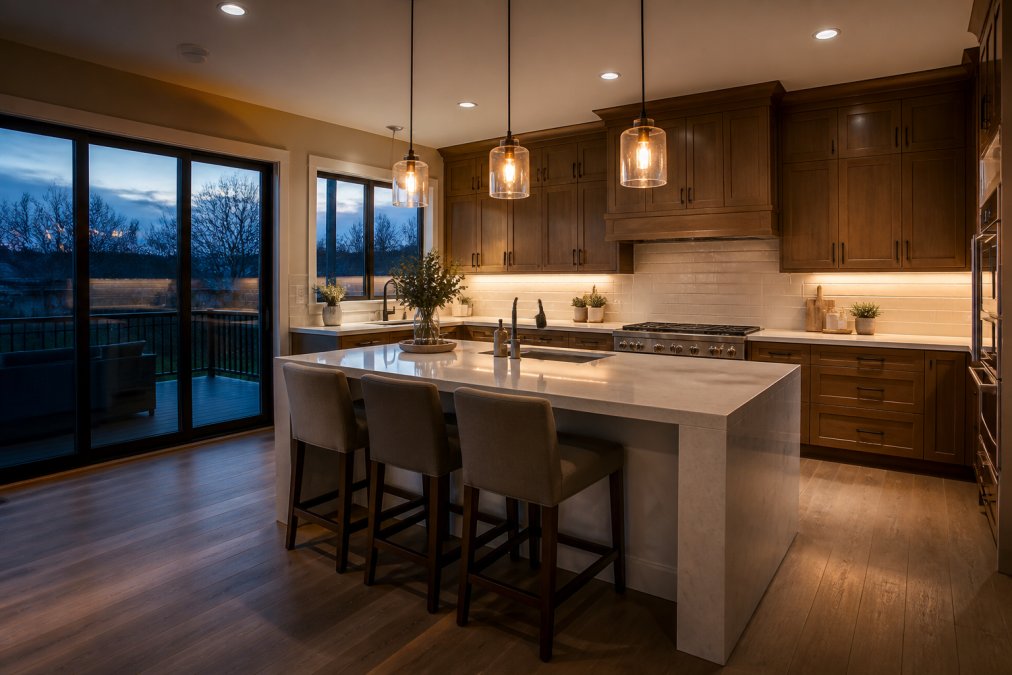
What Buyers Notice in the First 30 Seconds
Buyers scan for brightness, evenness, and warmth, in that order. A kitchen that photographs well but feels gloomy in person reads as a project, not a finished home, and projects get discounted.
How Lighting Influences Appraisal and Perceived Quality
Appraisers assess condition and quality, not mood, but perceived quality feeds directly into both. Even, layered light signals a maintained, thoughtfully finished home, which supports a stronger comparable valuation.
How to Layer Kitchen Lighting for Maximum Impact
Layering means combining three light types so no single source has to do all the work. Get the layers right and the room works at 6 a.m. and at 9 p.m. without touching a switch.
Ambient, Task, and Accent: The Three Layers Explained
- Ambient lighting is the general wash that makes the room usable, usually recessed ceiling fixtures or a central fixture.
- Task lighting is directed light for work: under-cabinet strips, a range hood light, an island pendant.
- Accent lighting highlights features: toe-kick glow, in-cabinet strips, a lit backsplash.
Fixture Placement and Shadow Reduction
Shadow reduction is about positioning, not wattage. Place task light in front of your body, not behind it, so your own shadow doesn’t fall on the cutting board. Under-cabinet strips belong at the front edge of the cabinet, not buried at the back wall.
Best Kitchen Lighting for Resale Value: What to Install
The best kitchen lighting for resale value is dimmable LED in three layers, with the color temperature matched across fixtures. Mismatched color temperature is the fastest way to make a new kitchen look cheap.
Recessed, Under-Cabinet, and Pendant Options
- Recessed lighting delivers even ambient light and disappears into the ceiling.
- Under-cabinet lighting is the single highest-impact task upgrade for the money.
- Pendant lights anchor an island and act as a design statement.
Color Temperature and Lumens: Getting the Numbers Right
Color temperature is measured on the kelvin scale, and for a kitchen the sweet spot is warm white, roughly 2700K to 3000K. Cool white reads clinical in a home kitchen; daylight above 4000K is for garages and workspaces.
| Layer | Typical Fixture | Job It Does | Resale Impact |
|---|---|---|---|
| Ambient | Recessed LED | Even general light | High |
| Task | Under-cabinet strip | Workspace visibility | Highest |
| Accent | Pendant, in-cabinet | Aesthetic appeal | Medium-high |
Kitchen Renovation ROI: The Financial Case for Better Lighting
Kitchen renovation ROI depends on what you spend it on, and lighting is one of the cheapest ways to lift perceived quality. You can’t quote a return without knowing your scope, but the pattern holds: lighting punches above its weight relative to its share of the budget.
Why Lighting ROI Is Hard to Quote, and How to Reason About It
No appraiser assigns a line item to a dimmer or an under-cabinet strip. What lighting does is protect and amplify the value of everything else in the room. A $40,000 kitchen with flat, single-source light reads like a $25,000 kitchen; the same kitchen with layered, dimmable light reads like the $40,000 you spent. That’s the mechanism: lighting doesn’t add value on its own, it prevents the rest of your renovation from being discounted.
ROI Breakdown by Fixture Type
Here’s how the major fixture categories compare on cost-to-impact. Treat these as planning bands, not quotes, your electrician’s rates and your ceiling structure will move the numbers.
| Fixture Type | Typical Installed Cost | What It Delivers | Cost-to-Impact |
|---|---|---|---|
| Under-cabinet LED strip | Lowest of the three | Eliminates counter shadows, makes backsplash and counters read clean | Highest, smallest spend, most visible daily payoff |
| Recessed LED (pot lights) | Mid to high, scales with count | Even ambient wash, modernizes the whole ceiling plane | High, biggest visual change per room, but requires ceiling access |
| Pendant lights over island | Mid per unit, plus junction box and bracing | Design anchor, defines the island as a focal point | Medium-high, strong style signal, weaker on pure function |
| In-cabinet and toe-kick accent | Low to mid | Depth, warmth, evening mood | Medium, aesthetic lift, rarely a buyer’s first question |
| Smart dimmer controls | Low per switch | Scene control, energy savings, modern-buyer signal | High, small line item, disproportionate perceived-tech upgrade |
Lighting rarely shows up as its own appraisal line. Its ROI shows up as protection: it stops buyers from discounting the cabinets, counters, and appliances you already paid for.
Smart Lighting Integration and Energy Efficiency
Smart lighting integration lets a kitchen shift scenes with one tap, bright and cool for morning prep, warm and dimmed for dinner, and it pairs naturally with LED technology, which uses a fraction of the energy of older incandescent and halogen bulbs. Energy efficiency is now a selling point buyers ask about directly, and a kitchen that already runs on LED with programmable dimming answers that question before it’s asked.
What Actually Moves the Number at Resale
Three things consistently separate a kitchen that supports its asking price from one that drags it down:
- Evenness. No dark corners, no single hot spot. Buyers read uneven light as ‘unfinished.’
- Control. Dimmers on every layer, so the room works at 6 a.m. and 9 p.m. without swapping bulbs.
- Consistency. One color temperature across all fixtures. Mismatched kelvins are the fastest way to make new finishes look cheap.
Lighting for Aging-in-Place and Daily Rhythm
This is the angle most kitchen lighting guides skip entirely, and it’s the one that quietly adds the most durable value: lighting designed for how eyes and bodies actually change over time. A kitchen that works for a 35-year-old and a 75-year-old is a kitchen that works for more buyers, for longer.
Why Aging Eyes Need Different Light
As eyes age, the lens stiffens and the pupil admits less light. The practical result is that an older homeowner needs meaningfully more light to see the same detail a younger person sees easily, often two to three times as much for close work like reading a recipe or trimming vegetables. Glare becomes more painful at the same time, because the aging lens scatters light instead of focusing it cleanly.
The Design Moves That Make a Kitchen Age-Friendly
- Brighter task zones, not brighter rooms. Push lumens onto the counter and the range, not into the ceiling. Under-cabinet strips do this better than any overhead fixture.
- Diffused, not bare. Choose fixtures with diffusers or shields so you see the light, not the bulb. Exposed LEDs at eye level are a glare source.
- Layered control. Dimmers and multiple switches let one person work in bright task light while another sits at the island in soft ambient light.
- Reachable, obvious switches. Rocker switches at the room entry and at both ends of the work zone. Avoid anything that requires a phone app to turn on the main light.
- Contrast at edges. Light the toe-kick and the counter edge so the eye can read where surfaces begin and end. This reduces trips and stumbles more than raw brightness does.
- Motion-sensing under-cabinet light. Hands-free light for a late-night glass of water is a small upgrade with outsized safety value.
If you’re planning a renovation you intend to stay in for decades, design the lighting for the version of yourself who will live there in twenty years. The cost difference at build time is small; the retrofit cost later is not.
Daily Rhythm: Light That Follows the Clock
Daily rhythm matters too. Bright, cooler light in the morning supports alertness; warm, dimmed light in the evening supports the circadian rhythm and better sleep. A layered, dimmable kitchen lets you follow that cycle without changing a single bulb, you’re just choosing which layer is on and how high.
Why This Adds Resale Value
Universal design is no longer a niche concern. Multi-generational households, aging homeowners who want to stay put, and buyers shopping for parents all read an age-friendly kitchen as a more capable kitchen. Lighting that’s brighter where it needs to be, glare-free, and easy to control signals a home that was designed thoughtfully, and that perception supports the price in the same way layered ambient light does.
Common Kitchen Lighting Mistakes to Avoid
- One central fixture doing all the work
- Mixing color temperatures across fixtures
- Placing task light behind your body instead of in front
- Skipping dimmer switches
- Forgetting toe-kick and in-cabinet accent light
- Choosing brightness by wattage instead of lumens
The most expensive mistake is planning lighting last. When it’s an afterthought, you’re patching circuits and repainting ceilings instead of enjoying the room.
Frequently Asked Questions
What is the 5’7″ lighting rule?
The 5’7″ rule is a guideline for pendant light placement: hang pendants so the bottom sits about 5 feet 7 inches from the floor, or roughly 30 to 36 inches above an island counter. This height keeps sightlines open and reduces glare. For ceilings above 2.4 metres, raise pendants slightly. Always check that the fixture does not block views across the kitchen.
Does upgrading kitchen lighting provide a good return on investment?
Lighting upgrades often deliver strong returns because they are less expensive than full cabinetry replacements but dramatically change how a kitchen feels. A layered lighting plan with LED fixtures can improve perceived quality and buyer interest. While exact ROI varies by market and home, kitchen renovation ROI generally ranks among the highest of any interior project, and lighting is a low-cost way to capture that value.
How does kitchen lighting affect the appraisal value of a home?
Appraisers assess condition, updates, and buyer appeal. Well-designed lighting signals a maintained, modern home, which can support a higher valuation. Dark or outdated lighting may read as deferred maintenance. A lighting plan that includes task, ambient, and accent layers, plus energy-efficient LEDs, helps justify the kitchen’s contribution to overall home value during an appraisal.
What is the difference between task, ambient, and accent lighting in a kitchen?
Ambient lighting provides overall illumination, usually from ceiling fixtures or recessed lights. Task lighting focuses on work areas like counters and sinks, often through under-cabinet fixtures. Accent lighting highlights features such as backsplashes or open shelving. Together, these three layers reduce shadows and make the kitchen safer, more functional, and more visually appealing to buyers.

Table of Contents
Start With Project Goals and a Clear ScopeDefine Menu and Service RequirementsSet Measurable Renovation GoalsCommercial Kitchen…

Table of Contents
Diagnose Your Basement Moisture Before InsulatingIdentifying water intrusion sourcesMeasuring moisture levelsBest Insulation for…