
Alternatives to Bathroom Vanity Cabinets: 7 Options
Table of Contents
- Why Homeowners Are Moving Away from Traditional Vanity Cabinets
- Bathroom Vanity Without Cabinets: Open Shelving Bathroom Storage
- Floating Bathroom Vanity Ideas for Small and Mid-Size Spaces
- Furniture Bathroom Vanity Ideas: Repurposing Dressers, Sideboards, and Tables
- Comparing Alternatives by Cost, Storage, Installation, and Bathroom Size
- Medicine Cabinets, Recessed Storage, and Other Supplementary Options
- Renter-Friendly and Accessible Bathroom Vanity Alternatives
- Conclusion
- Frequently Asked Questions
Last Updated: October 12, 2026
Why Homeowners Are Moving Away from Traditional Vanity Cabinets
Alternatives to traditional bathroom vanity cabinets are drawing more interest as homeowners look for storage that fits awkward spaces, suits older plumbing, and costs less to install. A closed vanity cabinet is not the only answer, and for many bathrooms it is not the best one. In this guide, we break down seven options worth considering, from open shelving to repurposed furniture.
The shift is practical, not aesthetic. Standard vanities come in fixed widths, and older bathrooms rarely match those dimensions. When a cabinet does not fit, the usual fix is to build out a wall or order a custom unit, both of which add cost and time. Homeowners also want to see their plumbing and shut-off valves, which a closed cabinet hides.
Traditional cabinets still work well in many bathrooms. They hide clutter, protect stored items from moisture, and offer a clean look. The alternatives below make sense when space, budget, or accessibility is the bigger constraint.
Here is how the seven options compare at a glance:
| Option | Storage | Installation | Best For |
|---|---|---|---|
| Open shelving | Low to medium | Easy | Small bathrooms, renters |
| Floating vanity | Medium | Moderate | Tight floor space |
| Repurposed furniture | Medium to high | Moderate to hard | Character, larger bathrooms |
| Pedestal sink | None | Easy | Tiny powder rooms |
| Medicine cabinet | Low | Easy | Extra storage anywhere |
| Recessed storage | Low to medium | Moderate | Walls with cavity space |
| Freestanding unit | Medium | Easy | Renters, quick upgrades |
Bathroom Vanity Without Cabinets: Open Shelving Bathroom Storage
A bathroom vanity without cabinets trades concealed storage for easy access and a lighter look. Open shelving bathroom storage works best when you accept that everything on display needs to earn its place. Rolled towels, matching jars, and a few well-chosen bottles look intentional. A jumble of half-used products does not.
Think of open shelving as a display system with a storage job, not a place to hide things. If you need to store cleaning supplies, medication, or anything you would rather not see, pair the shelves with a closed medicine cabinet or a lidded basket.
Open Shelving Materials That Handle Bathroom Humidity
Moisture is the deciding factor for material choice. Solid wood and reclaimed wood look warm but need a water-resistant finish to survive a steamy bathroom. MDF swells when water reaches its core, so it belongs only in well-ventilated rooms. Metal, glass, and sealed natural stone hold up better. Whatever you choose, seal it, and expect to re-seal every year or two.
Floating Bathroom Vanity Ideas for Small and Mid-Size Spaces
Floating bathroom vanity ideas solve a specific problem: floor space. A wall-mounted unit clears the floor underneath, which makes a small bathroom feel bigger and easier to clean. It also puts the basin at a height you can set yourself, which matters for taller or shorter users.
The catch is structural. A floating vanity needs blocking or a reinforced wall to carry its weight, and the plumbing has to route through the wall rather than down through a cabinet. In an older home, that often means opening the wall to move the drain.
Wall-Mounted Vanity Installation and Plumbing Considerations
Plan the plumbing before you buy the unit. The drain and supply lines must line up with the vanity’s interior, and a P-trap needs enough clearance to meet code. If the wall is not load-bearing or lacks blocking, a contractor can add support. This is the point where a simple swap turns into a small renovation.
Furniture Bathroom Vanity Ideas: Repurposing Dressers, Sideboards, and Tables
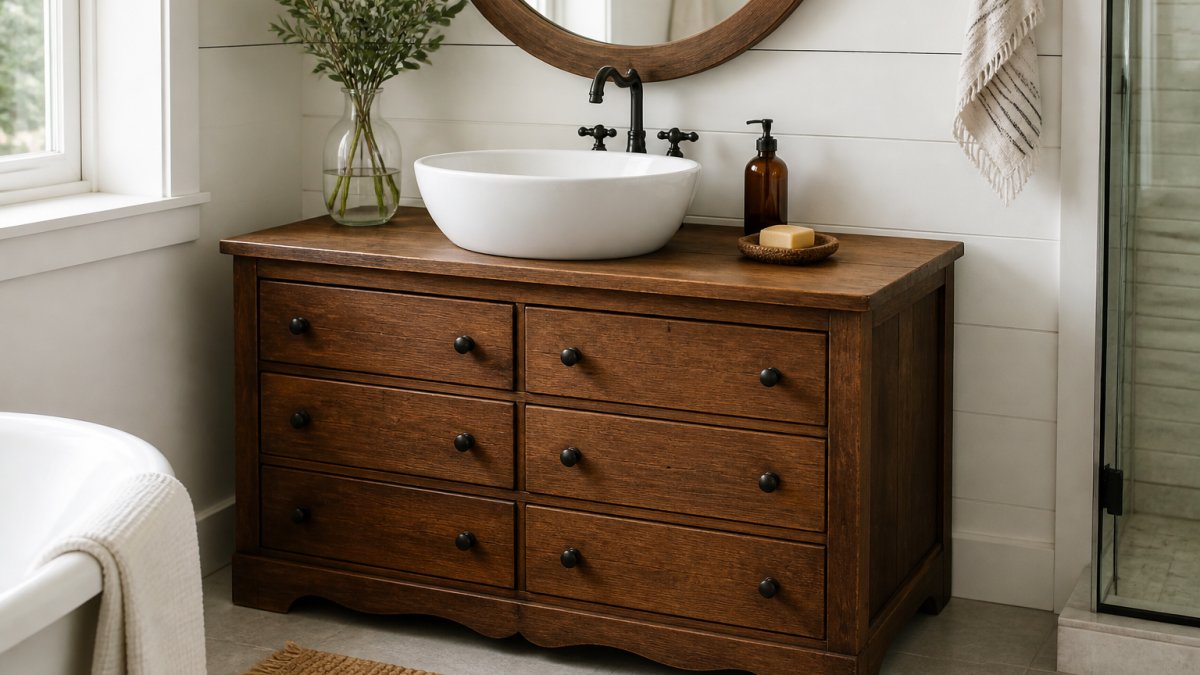
Furniture bathroom vanity ideas turn a dresser, sideboard, or vintage table into a one-of-a-kind vanity. A dresser vanity offers deep drawers and real character at a fraction of the cost of a custom cabinet. A sideboard or media cabinet can work in a wider bathroom, and a vintage table suits a powder room where storage matters less.
Protecting Repurposed Furniture from Moisture and Water Damage
Repurposed furniture needs protection before it goes in a bathroom. Seal every surface, including the inside of drawers, with a waterproof coating. Cut a plumbing opening in the back and reinforce the top to support the basin. Solid wood and reclaimed wood handle humidity better than particleboard, which swells and crumbles when wet. Check that the piece is tall enough for a comfortable sink height and stable enough to hold a countertop and basin.
Comparing Alternatives by Cost, Storage, Installation, and Bathroom Size
Cost, storage, installation difficulty, and bathroom size decide which option fits. None of these alternatives carries a fixed price, because material, labor, and plumbing work vary by project. What you can compare is the effort each one demands, how much it stores, and how well it suits a given footprint. The table below turns the broad categories into a decision tool.
| Option | Typical material cost | Storage capacity | Installation difficulty | Best bathroom size | Plumbing work needed |
|---|---|---|---|---|---|
| Open shelving | Low | Low to medium | Easy (brackets into studs or anchors) | Small to mid-size | None if shelves sit above existing sink |
| Floating vanity | Moderate | Medium | Moderate (blocking or reinforced wall) | Small, tight floor space | Drain and supplies must route through wall |
| Repurposed furniture | Varies with piece | Medium to high | Moderate to hard (cutout, sealing, top reinforcement) | Mid-size to large | Cutout for drain and supplies; P-trap clearance |
| Pedestal sink | Low | None | Easy | Tiny powder room | Standard rough-in, no cabinet to hide lines |
| Medicine cabinet | Low | Low | Easy (surface-mount) or moderate (recessed) | Any | None |
| Recessed storage | Moderate | Low to medium | Moderate (wall cavity required) | Any with cavity space | None |
| Freestanding unit | Low to moderate | Medium | Easy (no wall attachment) | Any, renter-friendly | None if unit is pre-drilled |
How to read the table. Material cost is the cost of the unit or components, not labor. A floating vanity or repurposed dresser often costs less in materials than a custom cabinet but more in labor, because the wall or the furniture has to be modified. A pedestal sink and a medicine cabinet are the cheapest and easiest to install, but they store almost nothing, so they work best paired with another option.
By bathroom footprint.
- Powder room (under 5 sq m): Pedestal sink plus a recessed medicine cabinet. No cabinet to crowd the floor, and the mirror cabinet holds the essentials.
- Small full bathroom (5 to 8 sq m): Floating vanity or open shelving. A floating unit clears the floor; open shelving keeps the room feeling light. Add a medicine cabinet for closed storage.
- Shared bathroom (8 to 12 sq m): Repurposed dresser or a freestanding unit with a medicine cabinet. Drawers and compartments matter more than floor clearance here.
- Large bathroom (over 12 sq m): Repurposed sideboard or media cabinet with open shelving on the walls. You have room for both display and concealed storage.
By household need.
- Renters: Freestanding unit, rolling cart, or over-the-toilet shelving. Nothing permanent, nothing drilled into tile.
- Accessibility: Wall-mounted vanity set at a reachable height with knee clearance underneath, plus open shelving at seated height. A standard cabinet blocks a wheelchair or walker.
- Low maintenance: Metal, glass, and sealed stone shelving, or a freestanding unit with a factory finish. Solid wood and reclaimed wood need re-sealing.
For a full picture of what each option involves, including plumbing and installation, Canada Mortgage and Housing Corporation’s renovation guidance is a useful starting reference.
Measure the drain centerline and supply line positions before you buy anything. Most vanity returns happen because the unit does not line up with the existing rough-in.
Medicine Cabinets, Recessed Storage, and Other Supplementary Options
Medicine cabinets and recessed storage add capacity without replacing your vanity. A recessed medicine cabinet sits inside the wall, so it adds storage without taking floor or counter space. This makes it a strong partner for open shelving or a pedestal sink, where primary storage is limited.
Other options worth knowing: a freestanding storage cabinet that can move with you, a slim tower beside the sink, or a mirrored cabinet above the basin. Each adds compartments without a full vanity build. For safety and ventilation standards that apply to bathroom work, Health Canada’s indoor air quality guidance offers useful context.
Renter-Friendly and Accessible Bathroom Vanity Alternatives
Renters and households with accessibility needs have options that avoid permanent changes. A freestanding vanity unit or a rolling cart can be removed when you move, and over-the-toilet shelving adds storage without drilling into tile. These reversible upgrades let you improve the space without losing a damage deposit.
Accessibility is the other angle most guides skip. A wall-mounted vanity set at the right height leaves room for a wheelchair or walker to roll underneath, which a standard cabinet blocks. Open shelving keeps everyday items within reach. If anyone in the household has mobility needs, talk to a contractor about height, clearance, and support before you buy anything.
Conclusion
Choosing among alternatives to traditional bathroom vanity cabinets comes down to your space, your plumbing, and how much you need to store. The wrong pick means a vanity that does not fit, plumbing that will not line up, or furniture that swells within a year.
Mario Laflamme Contracting & Renovation Ltd handles bathroom remodels, custom home builds, and essential exterior upgrades. Book a free consultation and we will help you find the right option for your bathroom.
Frequently Asked Questions
What can I use instead of a traditional bathroom vanity cabinet?
You have several practical options. A wall-mounted floating vanity saves floor space and makes cleaning easier. Open shelving with a vessel sink works well in small bathrooms.
A repurposed dresser or sideboard adds character and storage. Pedestal sinks with separate wall shelves suit tight footprints. Each alternative trades some concealed storage for openness, style, or cost savings.
The right choice depends on your bathroom size, plumbing layout, and how much you need to hide toiletries and cleaning supplies.
Can I use a dresser as a bathroom vanity?
Yes, dressers are one of the most popular furniture bathroom vanity ideas. You will need to cut a plumbing access hole in the back or bottom, reinforce the top to support a sink, and apply a waterproof coating to all surfaces. Solid wood or MDF with a sealed finish holds up best. Avoid particle board, which swells when wet. A contractor can handle the sink cutout, drain alignment, and sealing.
Are open shelves practical for bathroom storage?
Open shelving bathroom storage works well for frequently used items like towels, soap, and daily skincare. It keeps everything visible and accessible. The trade-off is dust and moisture exposure. Keep shelves at least 30 cm above the sink to reduce splash, use sealed wood or metal, and store only what you use regularly. Closed medicine cabinets or a small storage cabinet can handle items you want hidden.
What are the pros and cons of a floating bathroom vanity?
A floating bathroom vanity frees up floor space, makes small bathrooms feel larger, and simplifies mopping. Installation is more involved because the unit must be anchored into wall studs or blocking to support the weight of the countertop, sink, and contents. Plumbing must be routed inside the wall or concealed behind the unit. If your walls cannot support the load, a freestanding or furniture-based vanity is a safer choice.
Table of Contents
Start With Project Goals and a Clear ScopeDefine Menu and Service RequirementsSet Measurable Renovation GoalsCommercial Kitchen…
Table of Contents
Diagnose Your Basement Moisture Before InsulatingIdentifying water intrusion sourcesMeasuring moisture levelsBest Insulation for…