
5 Best Kitchen Flooring Materials for Busy Homes
Last Updated: October 26, 2026
Quick Summary
The best kitchen flooring materials for busy homes are luxury vinyl plank and SPC flooring, which offer excellent water resistance, durability, and minimal maintenance. For those prioritizing natural aesthetics, engineered wood or porcelain tile provide strong alternatives that balance performance with style.
- Luxury vinyl plank costs $6-$11 per square foot installed and requires only sweeping and occasional damp mopping
- Porcelain tile lasts 15-20 years or longer but requires periodic grout sealing and cleaning
- Hardwood needs refinishing every 7-10 years and is vulnerable to water damage in moisture-heavy kitchens
- SPC flooring’s rigid core resists denting better than standard LVP and maintains appearance through years of daily use
- Laminate costs $5-$9 per square foot installed but cannot be refinished and fails if water reaches the core
Table of Contents
- Why Kitchen Flooring Choices Matter for Your Home
- Kitchen Flooring Options: Material Comparison
- LVT Flooring Pros and Cons for Kitchen Use
- Waterproof Kitchen Flooring: What Actually Works
- Kitchen Flooring Installation Cost and Budget Planning
- Durability, Maintenance, and Long-Term Value
- Planning Your Kitchen Flooring Renovation
- Frequently Asked Questions
Why Kitchen Flooring Choices Matter for Your Home
The right kitchen flooring transforms how your space functions and feels. Kitchen flooring takes more wear than almost any other room in your home, daily spills, foot traffic, moisture, and temperature shifts all demand materials that can handle real life.
This guide covers kitchen flooring materials for busy homes, with comparisons of durability, water resistance, maintenance, and cost. Whether you’re planning a full renovation or replacing worn flooring, understanding your options helps you make a choice that lasts.
Kitchen Flooring Options: Material Comparison
Choosing the right kitchen flooring material means weighing performance against aesthetics and budget. The best kitchen flooring for your home depends on your household’s specific needs: families with young children and pets prioritize durability and easy cleanup, while others focus on style or long-term value.
Here’s a side-by-side comparison of the most popular kitchen flooring materials:
| Material | Durability | Water Resistance | Maintenance | Best For |
|---|---|---|---|---|
| Hardwood | Moderate | Low | Regular sealing | Traditional aesthetics |
| Engineered Wood | Good | Moderate | Periodic refinishing | Moisture-prone areas |
| Luxury Vinyl Plank (LVP) | Excellent | Excellent | Minimal | Busy families |
| Ceramic Tile | Excellent | Excellent | Grout maintenance | High moisture areas |
| Porcelain Tile | Excellent | Excellent | Grout maintenance | Heavy traffic |
| Laminate | Good | Moderate | Easy cleaning | Budget-conscious |
| SPC Flooring | Excellent | Excellent | Minimal | Modern kitchens |
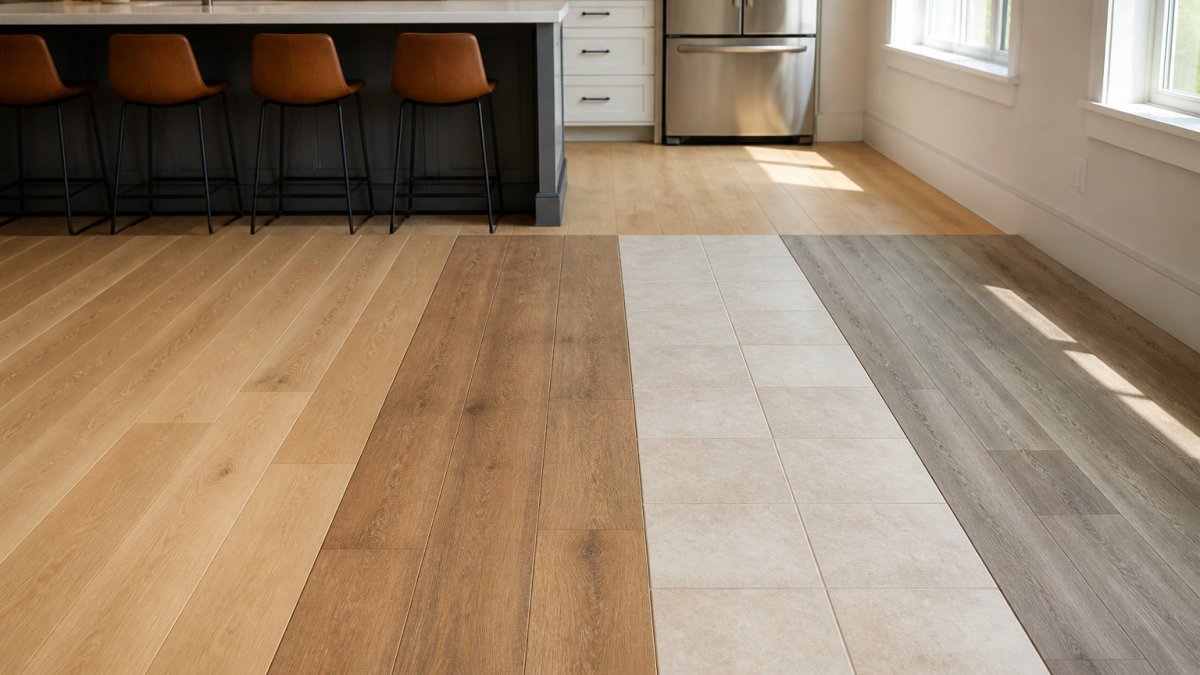
Hardwood and Engineered Wood
Hardwood remains a popular choice for kitchens because it brings warmth and traditional appeal. However, solid hardwood has significant limitations in moisture-heavy environments. Water damage, cupping, and warping are real concerns when spills happen regularly.
Engineered wood offers a practical middle ground. The plywood base resists moisture better than solid hardwood, while the real wood veneer maintains authentic appearance. Engineered wood works well in kitchens where you want the hardwood aesthetic without constant vulnerability to water damage. It’s easier to install over radiant heating systems than solid hardwood, which matters for renovations involving underfloor heating upgrades.
The trade-off: refinishing engineered wood is limited compared to solid hardwood. Once the veneer wears through, replacement becomes necessary rather than refinishing.
Luxury Vinyl Plank and SPC Flooring
Luxury vinyl plank flooring is one option for busy households. It mimics hardwood appearance while delivering water resistance and durability that solid wood cannot match. LVP handles spills, moisture, and heavy traffic without swelling or warping.
SPC (stone polymer composite) flooring is engineered vinyl’s tougher cousin. The rigid core construction makes it more stable and durable than standard LVP. SPC resists denting better and maintains its appearance through years of daily use. Both materials require minimal maintenance, regular sweeping and occasional damp mopping keeps them looking new.
The downside: vinyl flooring doesn’t add the same resale value as hardwood or tile, and some homeowners perceive it as less premium despite its practical advantages.
Ceramic and Porcelain Tile
Tile offers unmatched durability and water resistance. Ceramic tile is affordable and attractive, but porcelain tile performs better in kitchens. Porcelain is denser, more scratch-resistant, and holds up to dropped cookware without chipping as easily as ceramic.
The challenge with tile lies in grout maintenance. Grout absorbs stains and moisture, requiring regular sealing and cleaning. Modern grout options like epoxy are more stain-resistant than traditional cement-based grout, but they’re harder to install and more expensive. Unsealed grout becomes a maintenance headache in a kitchen where spills are frequent.
Tile also feels harder underfoot than wood or vinyl. Extended standing while cooking can cause fatigue. Thermal properties mean tile feels cold in winter, though radiant heating underneath addresses this concern.
LVT Flooring Pros and Cons for Kitchen Use
Luxury vinyl tile flooring is one option to consider for busy households. Understanding its real strengths and weaknesses helps you decide if it’s right for your kitchen.
Pros of LVT flooring:
- Waterproof core protects against spills and moisture
- Durable wear layer resists scratches and stains
- Easy to clean, sweep and damp mop, nothing more
- Wide range of wood-look and tile-look finishes
- Comfortable underfoot compared to hard tile
- Works well over radiant heating systems
- Affordable compared to hardwood or natural stone
Cons of LVT flooring:
- Lower perceived value than hardwood or tile
- Softer than tile, vulnerable to heavy furniture dents
- Quality varies significantly between brands
- Can feel slightly plastic-like despite improved designs
- Grout seams in tile-look vinyl still require attention
- Not ideal for very high-end homes where buyers expect natural materials
Waterproof Kitchen Flooring: What Actually Works
Water resistance matters in kitchens more than almost any other room. Understanding the difference between water-resistant and waterproof helps you avoid costly mistakes.
True waterproof flooring is rare. Most materials are water-resistant, meaning they tolerate occasional spills but fail if water sits for extended periods. Luxury vinyl plank and SPC flooring come closest to waterproof performance because their cores resist moisture penetration. Ceramic and porcelain tile are waterproof as materials, but grout lines remain vulnerable to water seeping underneath.
The real protection comes from proper installation. Underlayment beneath vinyl flooring prevents water from reaching the subfloor. For tile, professional installation with sealed grout and proper slope toward drains protects against standing water. Hardwood and laminate, even water-resistant varieties, should never be installed in kitchens without excellent moisture management underneath.
Watch out: a flooded kitchen reveals every flooring choice’s limitations. Engineered wood swells within hours. Laminate delaminates. Even luxury vinyl can fail if water sits under it long enough. The best defense is prevention, wipe spills immediately and address leaks from appliances or plumbing before they cause damage.
Kitchen Flooring Installation Cost and Budget Planning
Flooring costs vary dramatically based on material choice and installation complexity. Budget planning requires understanding both material and labor costs, plus hidden expenses like subfloor repair or underlayment. Most homeowners find that the installed cost, material plus labor plus preparation, is the number that matters, not the sticker price per square foot.
Material costs range widely. Laminate is most affordable. Luxury vinyl and ceramic tile sit in the mid-range. Hardwood and porcelain tile cost more. Professional installation adds significant expense, experienced installers charge more than inexperienced contractors, but the difference shows in longevity and appearance.
| Material | Material Cost (per sq ft) | Typical Installed Cost (per sq ft) | Notes |
|---|---|---|---|
| Laminate | $2-$5 | $5-$9 | Lowest upfront; sensitive to moisture |
| Luxury Vinyl Plank (LVP) | $3-$7 | $6-$11 | Includes underlayment; click or glue-down |
| SPC Flooring | $4-$8 | $7-$12 | Rigid core; often needs flat subfloor |
| Ceramic Tile | $2-$6 | $8-$15 | Grout and sealer add cost |
| Porcelain Tile | $4-$10 | $10-$18 | Denser body; higher labor for large format |
| Engineered Wood | $5-$12 | $10-$18 | Veneer thickness affects price |
| Solid Hardwood | $7-$15 | $12-$22 | Requires acclimation and careful moisture control |
Learn more about kitchen remodel budgeting to understand how flooring fits into your overall renovation timeline and expenses. For comprehensive planning, discover how long kitchen remodeling typically takes so you can budget both materials and labor accurately.
Durability, Maintenance, and Long-Term Value
The cheapest flooring upfront often costs more over time. Durability and maintenance demands shift the financial equation significantly. To compare fairly, look at the same measures for each material: expected lifespan under normal residential use, routine maintenance, repair options, and resale impact.
Hardwood requires regular maintenance, refinishing every 7-10 years, immediate attention to spills, and periodic resealing. Over 20 years, these costs accumulate. Solid hardwood can be refinished multiple times, which extends its service life, but moisture exposure remains its main vulnerability in a kitchen. Engineered wood has a thinner wear layer, so refinishing is limited, often once, sometimes not at all, and replacement of individual planks is possible but color matching can be difficult.
Laminate lasts 10-15 years before replacement becomes necessary. It cannot be refinished, and water that reaches the core causes swelling that is usually permanent. Localized repair is limited to replacing whole planks, which requires disassembly from the nearest wall, practical for small areas but disruptive.
Luxury vinyl and tile last 15-20 years or longer with minimal maintenance. LVP and SPC are among the easiest to repair locally: damaged planks can often be replaced individually if the installation method allows. Tile is extremely durable, but a cracked tile requires removing and replacing that piece, and matching grout color on an older floor can be challenging. Grout lines need periodic sealing and cleaning to prevent staining.
Maintenance reality: ceramic tile’s grout requires attention. Hardwood needs protection from moisture. Laminate can’t be refinished. Luxury vinyl demands almost nothing beyond regular cleaning. For busy households, the minimal maintenance of vinyl or SPC often outweighs the aesthetic appeal of other options.
Resale value matters if you plan to sell. Hardwood and tile appeal to buyers and support higher asking prices. Vinyl flooring, despite its practical advantages, doesn’t command the same premium. This matters most in higher-end homes where buyers expect natural materials.
A consistent comparison across the same criteria helps avoid marketing claims. Ask three questions for any material: How does it fail? How is it repaired? What does it cost per year to own? The answers usually matter more than the initial price per square foot.
Planning Your Kitchen Flooring Renovation
Starting a kitchen flooring project means preparing your home for disruption and making decisions about material, timeline, and budget. Connect with local kitchen remodel contractors to discuss installation options for your chosen flooring material. Learn how to prepare your home for kitchen renovation before work begins, proper preparation prevents delays and unexpected costs.
Choose your material based on honest assessment of your household’s needs. A family with young children and pets needs different flooring than empty nesters who rarely cook. High-moisture kitchens near bathrooms or with frequent humidity need water-resistant materials. Homes with radiant heating systems need materials compatible with that infrastructure.
The right kitchen flooring balances durability, maintenance, style, and budget. For most busy households, luxury vinyl plank or SPC flooring delivers the best practical performance. For homes where natural materials matter most, engineered wood or porcelain tile offer excellent alternatives. Get started with a free consultation to discuss your specific kitchen flooring needs and receive a customized recommendation based on your home’s conditions and your household’s lifestyle.
Frequently Asked Questions
What is the most water-resistant kitchen flooring material?
Luxury vinyl plank (LVP) and SPC (stone polymer composite) flooring are the most water-resistant options. Both have waterproof cores that prevent moisture penetration, making them ideal for kitchens where spills and humidity are common. Porcelain tile is also highly water-resistant but requires sealed grout lines. Laminate and standard hardwood absorb water and are not suitable for moisture-prone areas.
How much does kitchen flooring installation cost?
Kitchen flooring installation cost varies significantly by material and room size. Material prices range from budget laminate to premium hardwood, and installation labor depends on subfloor condition, existing floor removal, and local market rates. Contact Mario Laflamme Contracting & Renovation Ltd for a free consultation to get an accurate quote based on your specific kitchen size, material choice, and subfloor requirements.
What are the downsides of LVT flooring?
LVT flooring has several drawbacks: it can feel less authentic underfoot than real wood or tile, may emit volatile organic compounds (VOCs) if low-quality, can be damaged by sharp objects or heavy furniture, and some homeowners perceive it as less valuable than natural materials. Additionally, LVT cannot be refinished if damaged, so repairs often require full plank replacement. However, quality LVT offers excellent durability and water resistance at a lower cost than alternatives.
Which kitchen flooring is easiest to clean and maintain?
Luxury vinyl plank and porcelain tile are the easiest to clean. Both require only sweeping and occasional damp mopping with mild soap and water. LVP resists staining and doesn’t need sealing, while porcelain tile’s non-porous surface prevents dirt buildup. Hardwood requires more care (no excess water, periodic refinishing), and laminate can swell if moisture sits on the surface. For busy households, vinyl and tile minimize maintenance time and cost.

Last Updated: November 5, 2026
Quick Summary
Basement bulkhead framing involves constructing a boxed-in frame to conceal ducts, pipes, or cleanouts…

Last Updated: November 5, 2026
Quick Summary
The commercial renovation permit process in St. Albert starts by defining your scope, which decides…