
Which Basement Ceiling Works Best for Low Clearance?
Last Updated: October 27, 2026
Quick Summary
The best low clearance basement ceiling leaves the structure exposed and painted, because that keeps every inch of headroom. When you need a finished surface, drywall gives a clean, continuous look, while a drop ceiling sits lower on a grid and works where access matters most.
- Exposed painted joists keep all headroom, since nothing is added below the framing.
- Exposed services need tidy routing to look intentional and finished.
- Drywall gives a continuous, clean surface with no grid interruptions.
- A drop ceiling system installs on a grid below the joists, reducing headroom.
- Measure clearance from the finished floor to the lowest obstruction before choosing.
Table of Contents
- Why Low Clearance Changes Your Basement Ceiling Choice
- Exposed Basement Ceiling Ideas That Keep Every Inch of Height
- Drywall vs Drop Ceiling Basement: Which Gives More Headroom?
- Basement Ceiling Panels for Moisture-Prone Spaces
- Decorative Low-Clearance Options: Tiles, Beadboard and Stretch Fabric
- Basement Ceiling Lighting Ideas That Suit a Lower Ceiling
- Planning Your Low-Clearance Basement Ceiling With Mario Laflamme Contracting
- Frequently Asked Questions
Why Low Clearance Changes Your Basement Ceiling Choice
Choosing a basement ceiling in a low-clearance space is less about style and more about trade-offs. Every inch you add to a ceiling system comes out of your usable headroom. The first question is how much height you can afford to give up before the room starts to feel cramped.
A low-clearance basement ceiling is one where the distance from the floor to the underside of the joists or ducts leaves little room for a standard finish. The right choice depends on how much clearance you have, what runs overhead, and how you plan to use the space. For more height-focused tips, see finishing a basement with low ceilings. Each option below carries a different balance of headroom, access and appearance.
Exposed Basement Ceiling Ideas That Keep Every Inch of Height
Leaving the structure open is the most direct way to protect headroom. Exposed joists and services remain visible, so nothing is added between the floor and the underside of the framing. If beams or pipes are in the way, see finishing a basement with obstructions. This makes it a strong choice for a low-clearance basement where height matters most.
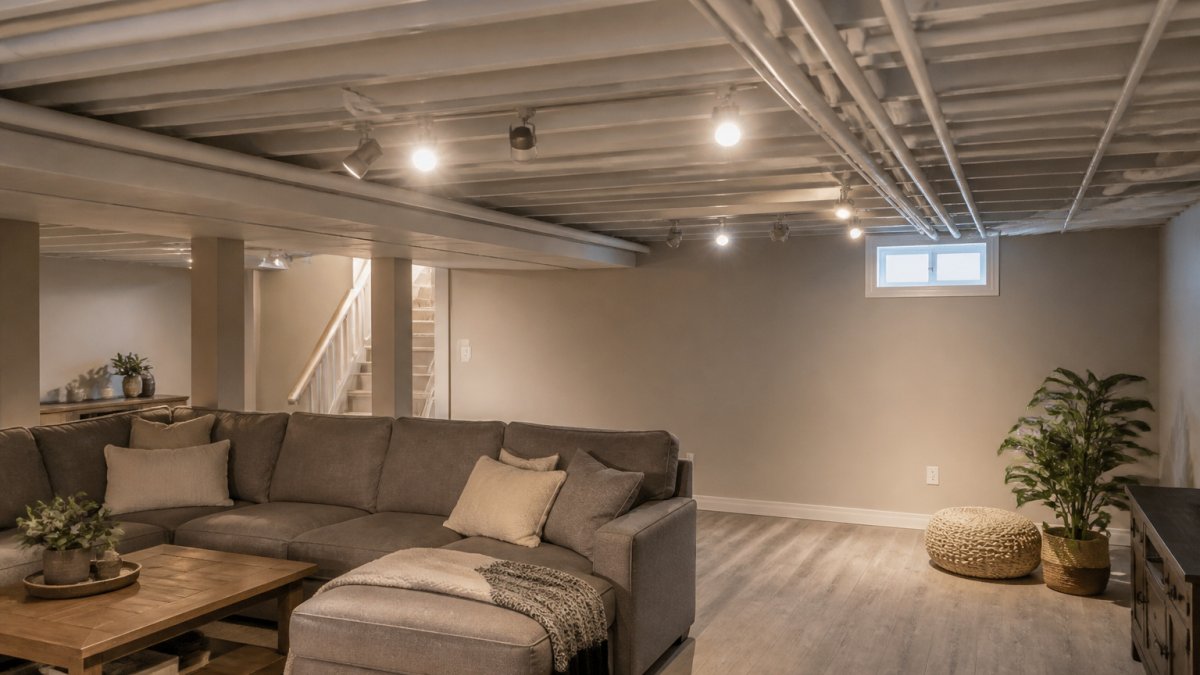
Painted exposed joists are the simplest version. Stained or painted, the joists become part of the room’s look rather than something to hide. The trade-off is that pipes, wiring and ducts stay in view, so the space needs to look intentional.
Painted open ceiling skips a suspended system entirely. Keep in mind that exposed services need tidy routing to look finished.
Drywall vs Drop Ceiling Basement: Which Gives More Headroom?
When you need a finished surface, the choice usually comes down to drywall or a drop ceiling. Drywall gives you a continuous, clean finish.
A drop ceiling system works differently. It sits below the structure on a grid.
The article compares drywall and drop ceilings on how much headroom each leaves you. If the ceiling must hide ducts, see strategies for finishing a basement with ducts.
| Option | Headroom | Key difference |
|---|---|---|
| Drywall | Continuous finish | Clean, uninterrupted surface |
| Drop ceiling system | Sits below the structure | Installs on a grid under the joists |
Basement Ceiling Panels for Moisture-Prone Spaces
Panels suit basements that need a finished look without the weight or maintenance of drywall. Panel systems do take up depth, so measure your clearance before choosing. To understand basement insulation for moisture control, read this guide. Confirm the specific product and its installation requirements with the manufacturer.
Decorative Low-Clearance Options: Tiles, Beadboard and Stretch Fabric
If you want a finished look with some character, several decorative options work in a low basement:
- Ceiling tiles give a defined, finished surface. Confirm the system depth, since tile installations vary.
- Beadboard adds visible texture and a panelled look. Check how much headroom your installation will use.
- Stretch fabric ceilings offer a soft, seamless finish. Clearance requirements and installation details should be confirmed with the supplier.
Each of these adds visual interest, but none is automatically the lowest-profile choice. Compare the installed depth against your clearance before you commit.
Basement Ceiling Lighting Ideas That Suit a Lower Ceiling
Lighting also helps a low room feel larger. Wall washers and indirect light draw the eye outward and reduce the sense of a closed-in ceiling. Plan the light layout before the ceiling is closed, so wiring can be run where it is needed.
Planning Your Low-Clearance Basement Ceiling With Mario Laflamme Contracting
Start by measuring your true clearance, from the finished floor to the lowest obstruction. Note where ducts, pipes and beams run, and decide which of them must stay accessible. Then match the ceiling type to that information: exposed structure for maximum height, drywall for a clean finish, or a drop ceiling where access matters most.
Mario Laflamme Contracting & Renovation Ltd offers comprehensive renovation solutions. If you are weighing these options for your own basement, contact us for a free consultation to talk through your clearance and layout.
Frequently Asked Questions
What is the best ceiling for a basement with low clearance?
For a low-clearance basement, consider how much depth each ceiling option adds. Measure the clearance first, then compare each option against that number.
Is drywall or a drop ceiling better for a low basement?
The choice depends on the basement’s clearance and the intended use of the space.
Can you leave basement joists exposed to make a ceiling feel higher?
The answer depends on the basement’s clearance and the intended look of the space.
Should I use 1/2-inch or 5/8-inch drywall for a basement ceiling?
The appropriate ceiling material and installation depend on the basement’s clearance and layout.

Last Updated: November 5, 2026
Quick Summary
Basement bulkhead framing involves constructing a boxed-in frame to conceal ducts, pipes, or cleanouts…

Last Updated: November 5, 2026
Quick Summary
The commercial renovation permit process in St. Albert starts by defining your scope, which decides…