
Kitchen Flooring for High Traffic: LVP vs Tile vs Laminate
Last Updated: November 19, 2026
Quick Summary
For high-traffic kitchen flooring, luxury vinyl plank is the most forgiving choice for busy households, since its thick wear layer resists scratches and stains. Porcelain tile lasts longest when the subfloor is sound, and laminate suits only drier kitchens because water swells its core.
- Check the wear-layer rating on vinyl; commercial-grade LVP is commonly 20 to 30 mils.
- Porcelain tile needs a flat, stable, dry subfloor, or grout lines and tiles can crack.
- Laminate swells when moisture reaches its seams and rarely returns to its original shape.
- Epoxy grout is denser and more stain-resistant than cementitious grout and does not need sealing.
- Ask for a manufacturer’s slip-resistance (COF) rating before choosing a glossy or matte finish.
Table of Contents
- Which Kitchen Flooring Holds Up Best Under Heavy Foot Traffic
- Luxury Vinyl Plank Kitchen Flooring: Wear Layers and Stain Resistance
- Porcelain Tile Kitchen Flooring: Durability, Cracking and Subfloor Needs
- Laminate and Engineered Wood in a Busy Kitchen: Moisture and Wear Limits
- Easy-to-Clean Kitchen Flooring and Slip Safety When Floors Get Wet
- A Kitchen Flooring Decision Matrix by Household Needs
- Booking Your Kitchen Floor Assessment and Installation Plan
- Frequently Asked Questions
Which Kitchen Flooring Holds Up Best Under Heavy Foot Traffic
Kitchen floors take more punishment than almost any other room in the house. Water, dropped pans, grit tracked in from the yard and daily foot traffic all wear them down. The three materials most homeowners compare are luxury vinyl plank (LVP), porcelain tile and laminate, and each handles that abuse differently. For a wider overview, see flooring materials for busy homes.
A question that comes up often in kitchen projects is which floor will still look good in ten years? The honest answer depends on how the kitchen is used, what sits under the floor, and how much maintenance you are prepared to do.
Kitchen flooring is any floor covering installed in a cooking and dining area, and for high-traffic use it has to resist scratches, moisture and staining at the same time. Most failures we are asked about come from one of three things: a surface layer that wears through, moisture that reaches the subfloor, or a tile that cracks under a heavy point load.
We cover each material below, then give you a decision matrix to match the floor to your household. The short version: LVP is the most forgiving for busy families, porcelain tile lasts longest if the subfloor is sound, and laminate works in drier kitchens but is the least tolerant of standing water.
Luxury Vinyl Plank Kitchen Flooring: Wear Layers and Stain Resistance
Luxury vinyl plank is a multi-layer synthetic floor made to look like hardwood or stone. Its durability comes almost entirely from the clear top layer, called the wear layer, which is measured in mils (thousandths of an inch). A thicker wear layer resists scuffs and scratches for longer.
Commercial-grade LVP is commonly described with wear layers of 20 to 30 mils. Check the wear-layer rating on any product you consider, because it is the number that predicts how the floor will look after years of use.
Stain resistance is the other key factor. A sealed vinyl surface wipes clean with little more than warm water, so spills from sauces, coffee and cooking oil rarely soak in. Look for products that list a stain-resistance or sealed-surface warranty, and confirm whether the warranty covers residential kitchens or only lighter residential use.
Watch out: cheap vinyl with a thin wear layer can dent under heavy appliances and chairs. If your kitchen has a heavy fridge or a large island, ask for the wear-layer rating before you buy.
Porcelain Tile Kitchen Flooring: Durability, Cracking and Subfloor Needs
Porcelain and ceramic tile are often considered for busy kitchens. They resist heat, water and staining, and a well-chosen tile can last for decades.
That rigidity makes the subfloor critical. Tile needs a flat, stable, dry base. A floor that flexes under foot traffic can crack grout lines and, over time, the tiles themselves.
Deflection is the technical term for how much a floor bends under load. Tile manufacturers generally publish a maximum allowable deflection for their products, and a structure that flexes too much can compromise a tile installation.
Moisture trapped under tile is another common failure point. Before a tile floor goes in, the subfloor should be inspected for levelness, soundness and moisture, and any problems fixed first. Trapped moisture can debond thinset, swell wood substrates and stain grout, and the damage often shows up months after the floor looks finished.
Grout choice matters as much as tile choice. Cementitious grout is porous unless sealed, and in a kitchen it collects grease, coffee and sauce. Epoxy grout is generally denser and more stain-resistant, and it does not need sealing.
Tile is hard underfoot and cold, and it gives little cushion when you stand at the counter for long periods. Some homeowners solve this with an anti-fatigue mat at the sink and stove.
Porcelain is generally denser and less porous than standard ceramic. Pick a textured or matte finish for better grip, and discuss grout type with your installer, since grout is usually the first part of a tile floor to stain.
Watch out: large-format tiles look dramatic but amplify any subfloor variation, so they need a flatter substrate and more careful installation than smaller tiles. A floor that passes a quick visual check can still fail if deflection or moisture was never measured.
Laminate and Engineered Wood in a Busy Kitchen: Moisture and Wear Limits
Laminate is a photo-printed layer bonded over a fibreboard core. It is affordable and looks convincingly like wood, and it is widely used in kitchens and other high-traffic areas. Its weakness is water. Laminate’s core swells when moisture gets into the seams, and once the boards swell, they rarely return to their original shape.
Because of that, laminate suits drier kitchens with good ventilation, careful cleanup habits and few spills near the sink or dishwasher. It is a poor fit for a kitchen where water pools regularly or where the floor sits over a slab that is prone to moisture.
Engineered wood is a layer of real hardwood bonded over a plywood or similar core. It is more stable than solid hardwood and can be refinished, which gives it a longer usable life than laminate. However, it still responds to standing water and high humidity, and the surface can scratch under grit and heavy chairs. A finish with a higher wear rating helps.
In short, both materials look good in a kitchen, but both need tighter limits on water and traffic than LVP or tile. Make sure the installer checks the subfloor moisture level before the boards go down.
Easy-to-Clean Kitchen Flooring and Slip Safety When Floors Get Wet
Cleaning ease and slip safety matter as much as durability. A floor that is hard to keep clean will look worn long before its wear layer is gone, and a slippery floor is a safety problem in any kitchen, especially one used by children and older adults.
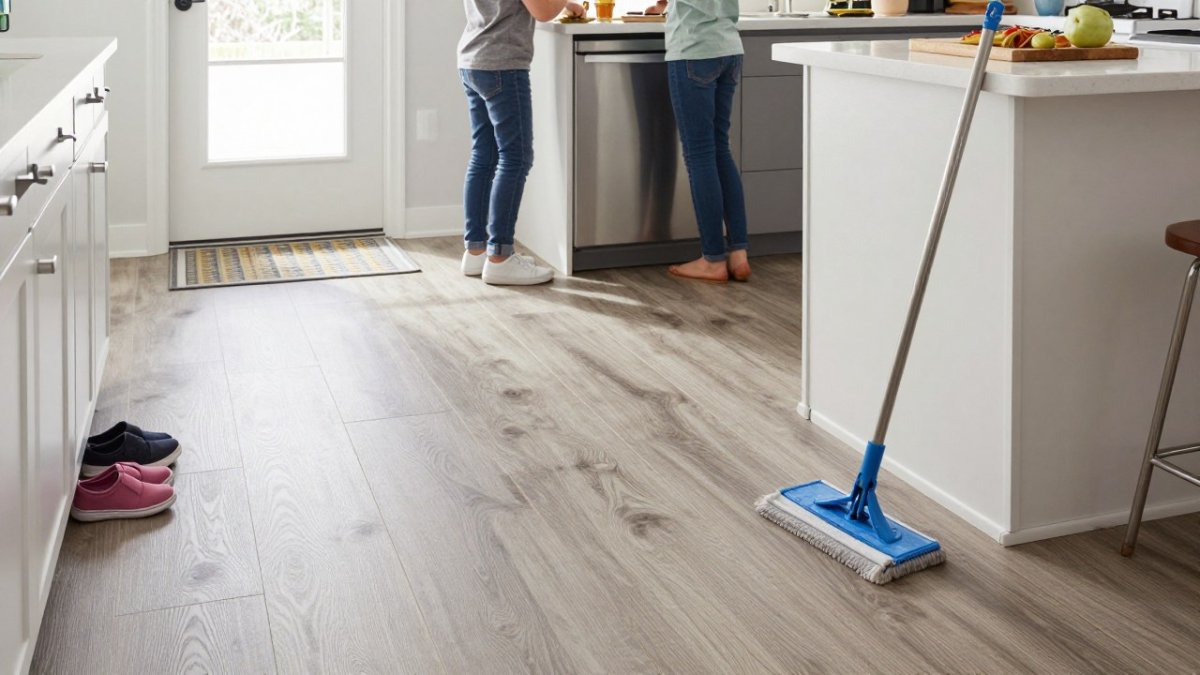
LVP and porcelain tile are the easiest to clean. A damp mop removes most messes, and neither material absorbs liquid. Laminate and engineered wood need a dry or barely damp cleaning method, because standing water can damage the seams.
Slip resistance depends on the surface texture, not just the material. Smooth, glossy tile or vinyl can become hazardous when wet or greasy. Look for a matte or textured finish and check the manufacturer’s slip-resistance rating before you buy. Slip-resistance is commonly expressed as a coefficient of friction (COF) (Slip-resistant footwear).
Texture cuts both ways. A deeply textured tile or embossed vinyl improves grip when wet but traps grease and flour in the surface, which makes daily cleaning harder. A lightly textured matte finish is usually the better balance in a kitchen.
A few small details help: wipe up spills promptly, keep a dry rug at the sink and stove, and avoid heavy wax or polish that builds a slick film. Runners and mats should have a non-slip backing; a loose mat is itself a trip hazard.
A family kitchen with children, pets or frequent cooking is where these choices matter most. Choose a floor that you can clean quickly and that gives you traction when it is wet. If someone in the household has mobility concerns, prioritize a matte, textured surface with a documented COF rating and keep the floor free of loose rugs and clutter.
Watch out: a floor that feels grippy when dry can still be slippery once a thin layer of cooking oil is on it, so test a sample with a little oil and water before committing to a large order.
A Kitchen Flooring Decision Matrix by Household Needs
Use this table as a starting point. The right floor depends on how your kitchen is used, not just on how it looks. To see how layout and work zones affect where high-traffic flooring matters most, read how to design a functional kitchen work triangle.
| Household need | Best fit | Why | Main caution |
|---|---|---|---|
| Young children, pets, frequent spills | LVP with a 20-mil or thicker wear layer | Resists stains and scratches, forgiving underfoot | Thin wear layers dent under heavy appliances |
| Heavy cooking, daily wet mopping | Porcelain tile on a stable, dry subfloor | Very water-resistant, long life | Cracks if the subfloor flexes; hard on joints |
| Drier kitchen, tighter budget | Laminate with a moisture-resistant core | Affordable, good wood look | Swells if water reaches the seams |
| Want real wood and can refinish later | Engineered hardwood | Can be sanded and refinished | Sensitive to standing water and humidity |
| Long-standing cook, joint comfort a concern | LVP or cushioned vinyl | Softer than tile | Check the wear-layer rating |
Lifecycle cost matters too. A cheaper floor that has to be replaced in five years can cost more than a mid-range floor that lasts fifteen. When you compare quotes, ask what the warranty covers, how the floor is repaired if one board or tile is damaged, and whether the product can be replaced later if it is discontinued.
Booking Your Kitchen Floor Assessment and Installation Plan
The right floor is easier to choose once someone has checked the subfloor, the moisture level and the layout of your kitchen. We recommend booking an assessment before you buy materials, so the installation plan matches both the floor and the structure beneath it.
A good assessment looks at the subfloor for levelness and moisture, identifies any repairs needed before installation, and compares the material options against how your household uses the room. Pricing depends on the material, the size of the room and the condition of the subfloor, so request a written quote from Mario Laflamme Contracting & Renovation Ltd for current pricing.
If you are planning a wider kitchen renovation, it helps to prepare the room early. Our guide on how to prepare your home for a kitchen renovation covers the steps to take before flooring work begins. Clear the space, plan where appliances and cabinets will sit, and confirm which work needs to happen before the new floor goes in. Mario Laflamme Contracting & Renovation Ltd offers a free consultation to walk through these choices with you. Contact us to book your kitchen floor assessment and get an installation plan built around your home.
Frequently Asked Questions
What is the best flooring for a high-traffic kitchen?
Luxury vinyl plank and porcelain tile are the two options most often recommended for busy kitchens. Commercial-grade luxury vinyl plank with a 20 to 30 mil wear layer is generally considered suitable for heavy use. Porcelain tile is also rated durable for high-traffic kitchens, though it can crack under a dropped pan and needs a stable subfloor. Pricing varies by product and project, so request a written quote from Mario Laflamme Contracting & Renovation Ltd for current pricing.
Is tile or luxury vinyl better for a busy kitchen?
Luxury vinyl tile resists stains and scratches and handles heavy foot traffic without showing much wear, and it does not crack or chip the way real tile can. Porcelain tile is harder and resists scratching, but it is rigid, so dropped heavy objects can chip or crack it, and it is harder on the legs during long periods of standing. Choose tile if hardness matters most and you can accept those trade-offs; choose vinyl if comfort and forgiveness matter more.
Is luxury vinyl flooring waterproof enough for a kitchen?
Luxury vinyl is water-resistant, which suits kitchens where spills are wiped up promptly, but water-resistant is not the same as waterproof at the seams. Standing water left for long periods can still penetrate joints and damage the subfloor. Proper installation, a moisture-tested subfloor and prompt cleanup of spills are what protect the floor over time.
What kitchen flooring is easiest to clean and maintain?
Vinyl and porcelain tile are among the easiest kitchen floors to clean, since neither needs sealing and both tolerate routine mopping. Grout lines in tile need periodic cleaning to resist staining, while vinyl seams need checking for lifting. Laminate is easy to sweep but is damaged by standing water, so it is less forgiving in a kitchen that sees frequent spills.

Last Updated: November 20, 2026
Quick Summary
Maintaining bathroom safety features for long-term use means running regular checks on grab bars,…

Last Updated: November 6, 2026
Quick Summary
The best ways to document home renovation for resale are to collect permits, inspection reports,…