
How to Budget for Exterior Home Renovations in 2026
Table of Contents
- Why Exterior Home Renovations Need a Realistic Budget
- Exterior Renovation Cost Breakdown: Where Your Money Goes
- How to Set Up a Home Renovation Contingency Fund
- Prioritizing High-ROI Exterior Upgrades
- Hiring Professional Renovation Contractors: What to Ask
- Financing Options and Payment Structures for Exterior Work
- How to Budget for Exterior Home Renovations: Step-by-Step
- Frequently Asked Questions
Last Updated: September 13, 2026
Why Exterior Home Renovations Need a Realistic Budget
Most homeowners underestimate exterior work because they price the visible material and forget everything underneath it. Learning how to budget for exterior home renovations starts with accepting that the number you see on a quote is rarely the number you pay. Many projects stall halfway through because the budget was built on optimism instead of scope.
An exterior renovation budget is a written plan that assigns a dollar figure to every stage of the work: materials, labour, permits, disposal, and a reserve for what nobody can see until the walls are open. Without that structure, a single rotted sheathing panel or a surprise permit requirement can push a project past its limit.
The stakes are higher than most people realize. Exterior work protects the entire structure, so delaying it to save money usually costs more later. A realistic budget keeps the project moving, keeps contractors paid on schedule, and keeps you in control of decisions instead of reacting to them.
The most expensive mistake is budgeting only for the finished surface. If your quote covers siding but not the sheathing, flashing, or trim behind it, you’re budgeting for roughly half the job. Set aside a reserve before you sign anything.
Exterior Renovation Cost Breakdown: Where Your Money Goes
An exterior renovation cost breakdown separates your project into four buckets: materials, labour, site preparation, and fees. Most homeowners focus on the first two and get blindsided by the last two.
Materials, Labor, and Site Preparation
Materials are the easiest line to estimate because suppliers quote them directly. Labour is harder, since it depends on access, height, and how much repair the substrate needs. Site preparation covers scaffolding, temporary protection, and clearing the work area, and it scales with how difficult your property is to reach.
A common mistake is treating site preparation as a rounding error. On a two-storey home with limited side access, staging and protection can quietly become one of the larger line items. Ask your contractor to itemize it separately rather than folding it into a single lump sum.
Permits, Disposal Fees, and Hidden Line Items
Permits and disposal are the two line items homeowners most often forget. Many municipalities require permits for structural changes, deck additions, and some roofing work, and the fees vary by scope. Disposal fees cover hauling away old siding, shingles, and debris, and they’re charged by weight or load.
Rather than guess at these numbers, confirm them with your local building department and ask your contractor how disposal is billed. A quote that lists permits and disposal as separate lines is easier to trust than one that buries them.
| Budget Category | What It Covers | Watch For |
|---|---|---|
| Materials | Siding, roofing, windows, fasteners | Price changes between quote and order |
| Labour | Installation, carpentry, finishing | Access and height surcharges |
| Site preparation | Scaffolding, protection, staging | Often under-quoted on tight lots |
| Permits and disposal | Municipal fees, debris hauling | Varies by scope and by municipality |
How to Set Up a Home Renovation Contingency Fund
A home renovation contingency fund is money set aside specifically for conditions you can’t see until work begins, such as rot, moisture damage, or outdated wiring behind exterior walls. It is not a slush fund for upgrades. It exists so a discovery doesn’t derail the whole project.
How much should you hold back? A common approach is to reserve a meaningful percentage of the total project cost, with older homes warranting a larger reserve than newer ones. The exact figure depends on the age and condition of your home, so discuss it openly with your contractor during quoting rather than picking a number at random.
Keep the fund separate from your project payments. If it sits in the same account, it gets spent on finishes and disappears right when you need it. Treat the contingency as untouchable until an actual hidden condition appears, and document every draw against it.
Ask your contractor to flag the three most likely hidden conditions for your specific home before work starts. On older properties, that’s usually moisture damage, failing flashings, and undersized framing. Knowing the likely culprits makes your reserve feel like a plan instead of a guess.
Prioritizing High-ROI Exterior Upgrades
Not every exterior project returns the same value, so prioritization matters as much as budgeting. The upgrades that protect the structure and improve curb appeal tend to hold value best, while purely cosmetic changes are the first to be cut when budgets tighten.
Rank your projects in this order:
- Water management first. Roofing, flashing, and drainage protect everything else. Fix these before anything decorative.
- Envelope second. Siding and windows improve energy efficiency and weatherproofing at the same time.
- Curb appeal third. Fencing, entryways, and landscaping integration lift home valuation but rarely fix underlying problems.
- Cosmetic last. Paint and trim are the cheapest to defer if the budget tightens.
This order also helps when you can’t afford everything at once. Phasing the work by priority means each stage builds on a sound base rather than covering up a problem you’ll have to reopen later.
Hiring Professional Renovation Contractors: What to Ask
Hiring professional renovation contractors comes down to verifying three things: licensing, insurance, and how they handle the unknown. A contractor who can’t answer clearly on any of these is a risk you don’t need to take.
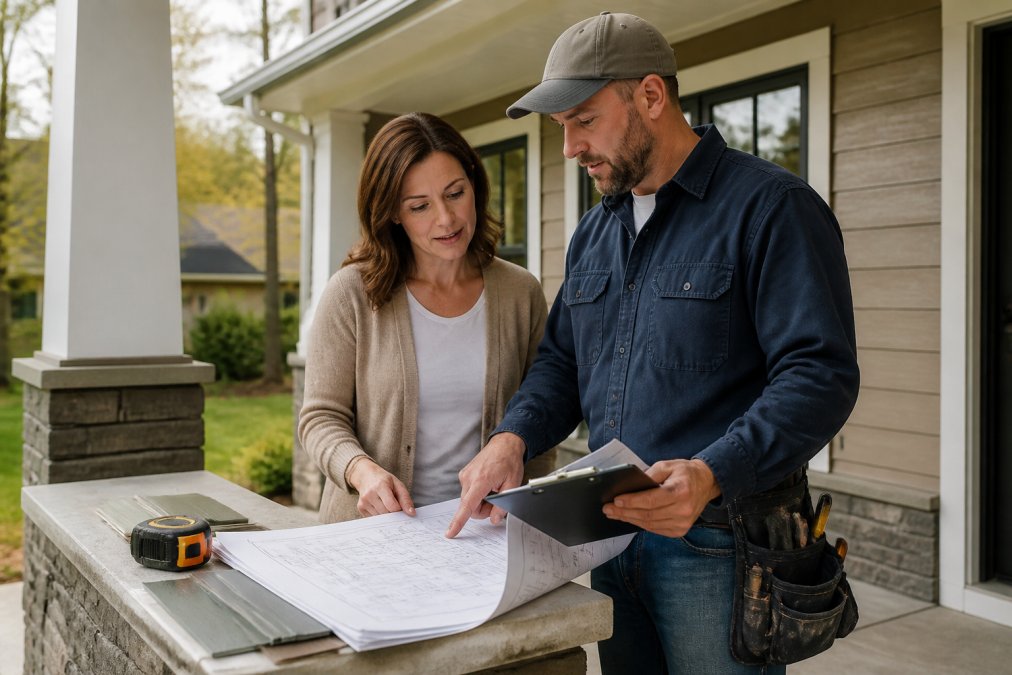
Bring this checklist to every quote:
- Are you licensed and insured, and can I see documentation?
- Will you provide references from similar projects I can call?
- How do you handle hidden conditions, and how are they billed?
- Is this a fixed-price contract or a cost-plus agreement?
- What’s the payment schedule, and how much is due upfront?
- Who handles permits, and are the fees included?
- What’s the renovation timeline, and how are delays communicated?
- Do you use subcontractors, and who manages them?
The difference between a fixed-price contract and a cost-plus agreement matters enormously here. Fixed-price locks your number but usually includes a higher base to absorb risk. Cost-plus bills actual costs plus a fee, which is fairer when scope is uncertain but leaves you exposed if you don’t trust the contractor’s accounting.
Homeowners who want budget certainty on well-defined exterior work, such as a straightforward siding replacement. If the scope is genuinely unknown, a cost-plus agreement with transparent reporting is the safer structure.
Financing Options and Payment Structures for Exterior Work
How you pay for exterior work matters as much as the total, and most guides skip this entirely. A renovation budget that ignores cash flow is only half a plan. The right structure depends on how certain your scope is, how long the work will take, and how much liquidity you want to preserve.
Matching the Financing Product to the Project
Savings and cash reserves. Paying from savings avoids interest and keeps the project debt-free, but it drains the same reserve you need for hidden conditions. If you use savings, ring-fence the contingency portion first and finance only the known scope.
Home equity line of credit (HELOC). A HELOC is a revolving, interest-only-until-draw facility secured against your home. It is well suited to phased exterior work because you draw only what each stage costs and can repay early without penalty. The trade-off: the rate is typically variable, so your carrying cost moves with the lender’s prime rate, and the debt is secured against your property. Under the federal Office of the Superintendent of Financial Institutions (OSFI) guideline B-20, federally regulated lenders apply a qualifying stress test to HELOCs and other mortgage credit, which can reduce how much you are approved to borrow (osfi-bsif.gc.ca).
Renovation or home improvement loan. A fixed-rate, fixed-term installment loan gives predictable payments and a defined payoff date, which suits a well-scoped project like a full siding replacement. You pay for that certainty with a higher rate than a secured HELOC and less flexibility if the scope shrinks.
Refinancing the first mortgage. Rolling renovation costs into a refinanced mortgage spreads repayment over a long amortization at a lower rate, but you pay interest for decades and reset your mortgage terms. It makes sense only when the renovation is large and the rate environment is favorable.
Government and utility programs. Before committing to a product, check whether your project qualifies for a grant, rebate, or interest-free loan. The Canada Greener Homes Initiative offered grants and interest-free loans for eligible energy-efficiency retrofits, including some envelope work, though program status and intake windows change (nrcan.gc.ca). Provincial and utility programs also exist and vary by region. Confirm current eligibility directly with the program administrator before you build a rebate into your budget.
Never treat a pending rebate or grant as cash in hand. Approvals can take months, and program funding can be exhausted. Budget the full cost and treat any rebate as a recovery, not as financing.
Payment Schedules That Protect You
Payment structure deserves equal attention. A schedule tied to verifiable milestones, such as completion of demolition, rough-in, and final inspection, protects both sides. Avoid large upfront deposits and never pay for work that has not been completed.
A common pattern that works well:
- Deposit on signing, small, enough to secure materials and a start date.
- Payment on demolition and site prep completion.
- Payment on rough-in or structural completion.
- Payment on substantial completion, minus a holdback.
- Final payment after inspection and your walkthrough sign-off.
In many provinces, construction and renovation work is governed by prompt payment and lien legislation that sets timelines for payment and for preserving a lien. These rules affect both you and your contractor, so confirm what applies in your province before you agree to a schedule. A holdback, typically a percentage of each progress payment, gives you leverage until deficiencies are corrected.
Contract Type Drives Your Risk
The difference between a fixed-price contract and a cost-plus agreement matters enormously here. Fixed-price locks your number but usually includes a higher base to absorb risk. Cost-plus bills actual costs plus a fee, which is fairer when scope is uncertain but leaves you exposed if you do not trust the contractor’s accounting. A third option, cost-plus with a guaranteed maximum price, caps your exposure while preserving transparency on actual costs.
Match the product to the risk: fixed-rate loan for a known scope, HELOC for phased or uncertain work, and a milestone-based payment schedule with a holdback in every case. Confirm any rebate eligibility before you rely on it.
How to Budget for Exterior Home Renovations: Step-by-Step
Here’s a process to consider, in order:
Step 1: Define the project scope. Write down exactly what’s being replaced, repaired, or added. Vague scope produces vague quotes.
Step 2: Get at least three itemized quotes. Compare line by line, not just the total. A low total often hides missing items.
Step 3: Separate the budget into categories. Materials, labour, site preparation, permits, disposal, and contingency. Every dollar gets a home.
Step 4: Set your contingency fund. Reserve a meaningful portion of the total for hidden conditions, larger for older homes.
Step 5: Confirm permits and fees. Check with your local building department and include the fees in your budget.
Step 6: Choose your payment structure. Match the contract type and payment schedule to how certain your scope is.
Step 7: Build in a timeline buffer. Exterior work is weather-dependent, so plan for delays on the schedule and in the budget.
Step 8: Review before you sign. Read the contract, confirm what’s included, and make sure the reserve is still intact.
For a more detailed look at how the Canada Mortgage and Housing Corporation advises homeowners on renovation planning and financing, their renovation guidance for homeowners is a useful starting point.
Exterior projects rarely go exactly to plan, and the homeowners who stay in control are the ones who budgeted for that reality. If you’d rather not manage the unknowns alone, Mario Laflamme Contracting & Renovation Ltd handles exterior upgrades including siding, roofing, and fencing, with professional project management from quote to final inspection. We help you scope the work and build a budget.
Get started with Mario Laflamme Contracting & Renovation Ltd and book a free consultation to put a realistic number on your project.
Frequently Asked Questions
What is a realistic renovation budget for exterior upgrades?
A realistic budget depends on scope, materials, and your home’s condition. Start by listing every project (roof, siding, windows, fencing) and get at least three written quotes for each. Add 15 to 20 percent as a contingency fund. For larger projects like full siding replacement, expect the budget to be driven mostly by material choice and labor, so compare quotes carefully and confirm what each one includes.
How much should I set aside for a contingency fund in my renovation budget?
Set aside 15 to 20 percent of your total project cost for a home renovation contingency fund. Older homes with unknown structural issues may need closer to 20 percent. This fund covers unexpected repairs like rotted sheathing, outdated wiring, or hidden water damage. Keep it separate from your main budget so you are not tempted to spend it on upgrades.
How do I account for material and labor costs in my renovation plan?
Break your exterior renovation cost breakdown into three buckets: materials, labor, and extras like permits and disposal fees. Materials typically include siding, roofing, windows, and finishes. Labor covers contractors, subcontractors, and site preparation. Get itemized quotes so you can see exactly what each line covers, and confirm whether the quote includes disposal, cleanup, and weatherproofing.
What should I ask when hiring professional renovation contractors?
Ask for proof of licensing and insurance, a written fixed-price contract with a clear scope, a timeline with milestones, and references from similar local projects. Confirm how they handle change orders and unexpected repairs. A reliable contractor will walk you through the budget line by line and explain what happens if costs change mid-project.

Table of Contents
Start With Project Goals and a Clear ScopeDefine Menu and Service RequirementsSet Measurable Renovation GoalsCommercial Kitchen…

Table of Contents
Diagnose Your Basement Moisture Before InsulatingIdentifying water intrusion sourcesMeasuring moisture levelsBest Insulation for…