
5 Factors That Drive Basement HVAC Duct Rerouting Costs
Last Updated: October 29, 2026
Quick Summary
Rerouting basement HVAC ducts means moving existing duct runs to clear beams, joists, plumbing and a new ceiling. The article does not give a verified Canadian price for this work, so no specific dollar range is stated. The main cost drivers are labour, duct material and fittings, insulation and sealing, and system rebalancing.
- Labour is usually the largest share of a basement duct reroute bill on residential jobs.
- Ask contractors to quote labour in hours rather than as a lump sum.
- Flexible duct costs less per foot but restricts airflow, so it suits short final connections.
- Sealing duct joints is a small material cost with a large effect on performance.
- Ask for system rebalancing as a separate line item on every quote.
Table of Contents
- Basement Ductwork Rerouting Cost Breakdown in CAD
- How to Reroute Ductwork Around Basement Beams
- Basement Duct Soffit Ideas Compared to Rerouting
- Keeping Airflow and Balancing Intact After the Work
- Booking a Free Consultation Before You Finish Your Basement
- Frequently Asked Questions
Rerouting basement HVAC ducts means moving existing duct runs so they clear beams, joists, plumbing and the new ceiling you plan to build. For a St. Albert homeowner finishing a basement, it is often the single biggest unknown in the budget. The question is: what will the ducts cost to move?
The price depends on the project scope.
Duct-specific price data is thin, and the research we reviewed does not give a verified Canadian figure for basement rerouting specifically. Published guides do give installation and labour benchmarks, but they often come from US markets or do not state the currency. For that reason, the ranges later are not CAD quotes for St. Albert, and we will not present them as such.
Project scope can affect costs.
Watch out:
Basement Ductwork Rerouting Cost Breakdown in CAD
A reroute bill typically splits into four buckets: labour, duct material and fittings, insulation and sealing, and system rebalancing. Labour is the largest share on most residential jobs, and it scales with linear feet of duct moved, the number of elbows and transitions, and how cramped the ceiling space is.
What Drives the Labour Line
Ask for the labour estimate in hours, not just a lump sum. A quote that says “12 hours plus materials” is easier to sanity-check than one that says “$2,400.”
Duct Material and Fittings
Rigid galvanized duct is priced per linear foot and per fitting. Flexible duct is cheaper per foot but has higher resistance to airflow, so it is usually limited to short final connections rather than long trunk runs. Elbows, wyes, takeoffs, and register boots are priced individually, which is why a path with many turns costs more in materials as well as labour.
Insulation, Sealing, and Vapor Control
Duct insulation in a basement serves two purposes: it reduces heat loss and it controls condensation on cold metal in humid summer air. Insulated flexible duct and duct wrap are both common. Sealing every joint with mastic or foil tape is a small material cost but a large performance factor, because leaky joints in a conditioned basement waste the air you paid to cool or heat.
System Rebalancing
After the ducts move, the system has to be tested and balanced. This is separate work from the install and should be a separate line on the quote. It involves measuring airflow at each register and adjusting dampers so rooms upstairs and down get the design airflow. Skipping it is the most common way a reroute ends up “working” on paper but leaving a bedroom too cold.
A Realistic Budget Framework
When you get quotes, ask each contractor to fill in those five lines. The contractor who can itemize them is the one who has actually planned the job, and the comparison will be far more useful than three lump sums that look similar.
The reroute bill splits into a few main buckets, each driven by different parts of the job.
| Cost bucket | What drives it | Note |
|---|---|---|
| Labour | Linear feet moved, elbows, ceiling space | Largest share on most residential jobs |
| Duct material and fittings | Rigid duct per foot, individual fittings | Flexible duct is cheaper per foot but restricts airflow |
| Insulation and sealing | Heat loss, condensation control, joint sealing | Small material cost, large performance effect |
| System rebalancing | Airflow measured and adjusted at each register | Should be a separate line on the quote |
How to Reroute Ductwork Around Basement Beams
Before the ceiling closes in, check that the system delivers air to each register. Browse proven strategies for working ducts into a finished basement layout for more options. This is also the best time to add access panels near dampers and filters, so future service is easy.
Basement Duct Soffit Ideas Compared to Rerouting
A soffit and a reroute solve the same problem, ductwork in the way of a finished ceiling, but they trade off differently, and the right choice depends on ceiling height, duct layout, and how much of the basement you are finishing. Most guides mention soffits in passing; this section treats the comparison as a decision, because it is the decision most homeowners actually face.
What a Soffit Actually Is
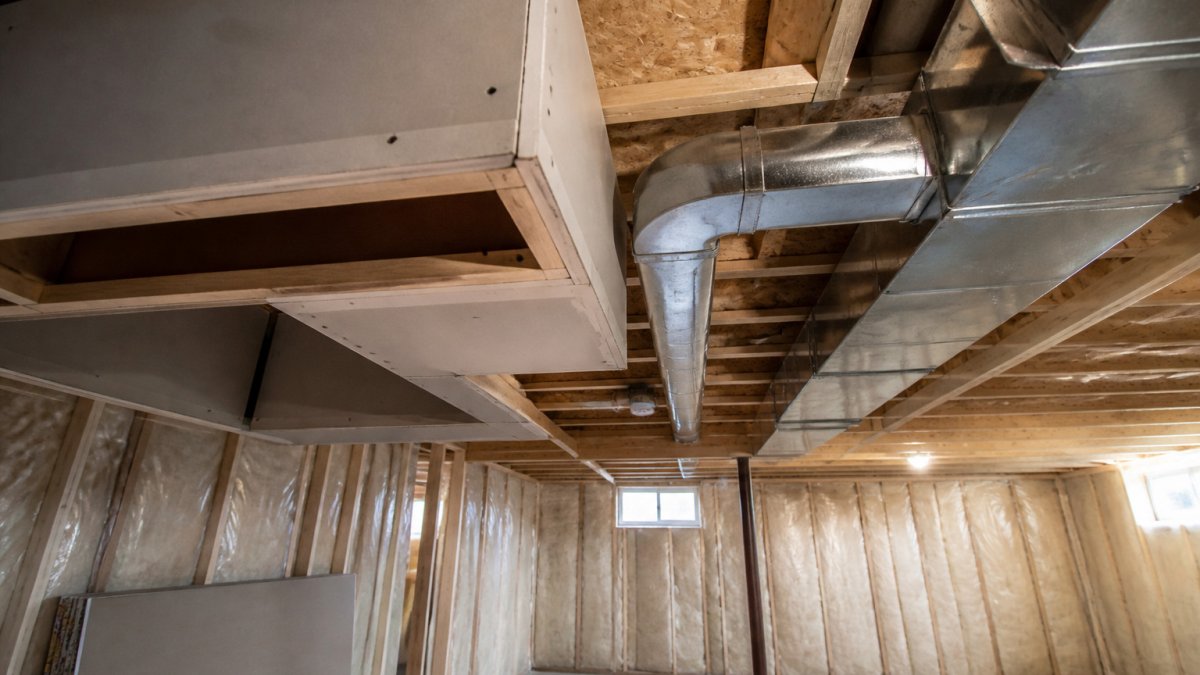
A soffit is a boxed enclosure built around ducts and pipes, usually framed with lumber and closed with drywall. It hides the duct without moving it. The trade-offs are ceiling height and visual bulk: a soffit typically drops the ceiling by the depth of the duct plus framing and drywall, and it creates a visible box that interrupts a flat ceiling.
What Rerouting Actually Costs You
Rerouting moves the duct out of the way so the ceiling can be flat. It preserves ceiling height and gives a cleaner finished look, but it requires skilled labour, new duct sections, fittings, sealing, and rebalancing. It also carries risk: a poorly planned reroute can reduce airflow to rooms upstairs or create condensation problems if insulation is inadequate.
The Decision Criteria That Matter
Compare the two on these axes before you choose:
- Ceiling height: If the basement ceiling is already low, a soffit may make the space feel cramped. Rerouting preserves height but costs more.
- Duct layout: A single straight run is a good soffit candidate. A trunk with multiple branches crossing the room is usually a reroute candidate, because boxing all of it creates a maze of soffits.
- Finished look: A flat ceiling reads as a more finished, higher-value space. Soffits are acceptable in utility areas but often disliked in main living areas.
- Budget: Soffits are usually less expensive because they avoid moving mechanical work. Rerouting costs more but delivers a cleaner result.
- Future access: Soffits can include access panels for dampers and filters. Reroutes should include access panels too, but the planning is different.
Hybrid Approaches
Many basements do not need an all-or-nothing choice. A common pattern is to reroute the main trunk that crosses the finished living area, and soffit the short branch runs near the utility zone or above a storage area. This keeps the visible ceiling flat where it matters and controls cost where it does not.
Questions to Ask Before Deciding
Ask your contractor three things: how much ceiling height each option costs you, whether the existing duct layout can be rerouted without reducing airflow to upper floors, and whether the soffit or reroute will include access to dampers and filters. The answers will usually make the choice obvious.
Keeping Airflow and Balancing Intact After the Work
Ask your contractor to confirm that the system was tested after the move. Learn how to soundproof basement ductwork effectively once the rerouting is finished. Our guide on choosing insulation that controls basement moisture explains how moisture affects duct performance. You want proof that airflow meets the design, not just a finished ceiling.
Booking a Free Consultation Before You Finish Your Basement
A free consultation is available to discuss your project.
book a free renovation consultation to discuss your project and next steps.
If you are still comparing approaches, read our guide on finishing a basement with obstructions for more context.
Frequently Asked Questions
How much does it cost to reroute basement HVAC ducts?
The cost depends on the project scope. Contact Mario Laflamme Contracting & Renovation Ltd through its website or request a free consultation to discuss your project.
Can basement HVAC ducts be rerouted without reducing airflow?
Whether ducts can be rerouted without reducing airflow depends on the project. Consult a qualified professional about the specific layout.
Is it cheaper to reroute ducts or build a soffit around them?
The right choice depends on the project. Consult a qualified professional about the options for your space.
How long does it take to reroute basement ductwork?
The timeline depends on the project. Ask the contractor about scheduling before work begins.


Last Updated: November 5, 2026
Quick Summary
The commercial renovation permit process in St. Albert starts by defining your scope, which decides…

Quick Summary
To vet a structural engineer for your home build, first confirm they hold an active professional engineering licence in your province…