
Laminate vs Solid Wood Kitchen Cabinets (2026 Guide)
Table of Contents
- Laminate vs Solid Wood Kitchen Cabinets: Key Differences at a Glance
- Laminate Kitchen Cabinets Pros and Cons
- Solid Wood Kitchen Cabinets Pros and Cons
- Durability, Water Exposure, and How Each Material Ages in a Real Kitchen
- The Cost of Laminate vs Solid Wood Cabinets: Upfront and Over Time
- How to Repair Laminate Cabinets: Chips, Peeling Edges, and Refinishing Limits
- Maintenance, Appearance, and Resale Value
- Conclusion: Choosing the Right Cabinet Material for Your Kitchen
- Frequently Asked Questions
Last Updated: October 5, 2026
Laminate vs Solid Wood Kitchen Cabinets: Key Differences at a Glance
Choosing between laminate vs solid wood kitchen cabinets comes down to one trade-off: laminate gives you a tough, uniform surface at a lower upfront cost, while solid wood gives you repairable, refinishable material that holds value longer. At Mario Laflamme Contracting & Renovation Ltd, we install both, and the right pick depends on your budget, household, and how long you plan to stay.
Laminate cabinets are engineered boards wrapped in a decorative surface layer. Solid wood cabinets are built from natural timber that can be sanded and refinished. Laminate wins on cost and easy cleaning; solid wood wins on longevity, repair, and resale appeal.
Most comparison guides get one thing wrong: they treat “laminate vs solid wood” as a two-way choice when it is really a five-way one.
| Factor | Laminate | Solid Wood |
|---|---|---|
| Upfront cost | Lower | Higher |
| Moisture tolerance | Good, if edges stay sealed | Moderate, needs protection |
| Wear resistance | High on the surface | Moderate, dents and scratches |
| Repairability | Poor once chipped | Excellent, sand and refinish |
| Best for | Rental units, busy family kitchens, tight budgets | Long-term homes, custom builds, resale |
What Each Material Actually Is: Solid Wood, Veneer, Laminate, TFL, and HPL
Solid wood is timber cut from a single species, used for door frames, panels, or full cabinet construction.
Wood veneer is a thin slice of real wood glued over a stable core, usually MDF or plywood.
Laminate is a decorative surface layer bonded to a substrate, often particleboard or MDF.
High-pressure laminate (HPL) bonds multiple layers under high pressure, making it denser and more wear-resistant than TFL.
The Cabinet Box: Why the Substrate Matters as Much as the Door
The box is the carcass behind the door, and its substrate decides how your cabinets handle moisture and weight.
Most North American cabinets use MDF, particleboard, or plywood boxes. Plywood holds screws better and resists moisture longer. Particleboard is flat and inexpensive but swells fast once water reaches the raw core.
When you compare laminate vs solid wood, ask what the box is made of before you compare the doors.
Laminate Kitchen Cabinets Pros and Cons
Laminate cabinets are the practical pick where budget and cleaning ease matter most: the surface wipes clean, resists stains, and comes in consistent colors across every unit.
Pros:
- Lower material and labor costs than solid wood
- Smooth, non-porous surface that does not need sealing
- Wide range of colors, textures, and wood-look finishes
Cons:
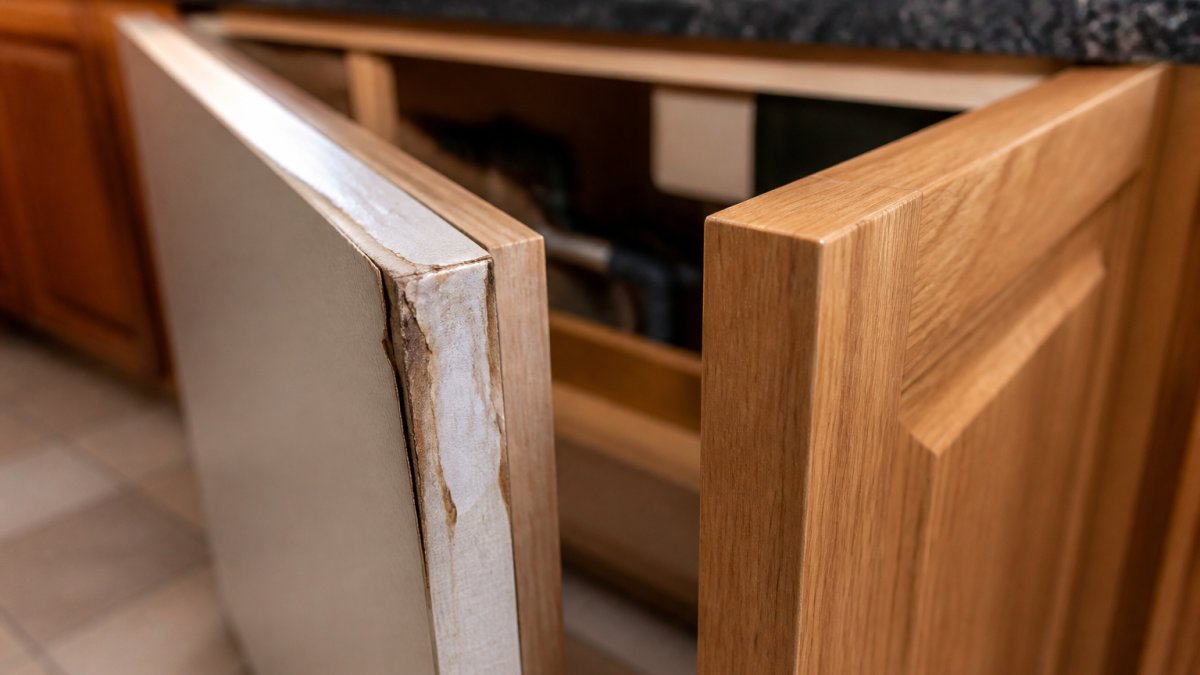
- Chips and peeling edges are hard to repair invisibly
- Swelling risk if moisture reaches the raw substrate
- Lower resale prestige than natural wood
The most common laminate failure is an unsealed edge. One dishwasher leak or a slow drip under the sink can wick into the core and swell the board within days. Caulk and edge banding are not cosmetic, they are the waterproofing.
Solid Wood Kitchen Cabinets Pros and Cons
Solid wood cabinets are the long-term investment. They can be sanded out, re-stained, and refinished, so a scratch today is not permanent.
Pros:
- Repairable and refinishable for decades
- Natural grain and character no print can copy
- Strong resale appeal in higher-value homes
Cons:
- Higher upfront cost
- Requires periodic sealing or oiling
- Can warp or crack if humidity swings are extreme
The thing nobody tells you about solid wood is that it moves. Wood expands and contracts with seasonal humidity, so door gaps change slightly between summer and winter, normal, not a defect.
Durability, Water Exposure, and How Each Material Ages in a Real Kitchen
Durability is not one property, it is six. Heat, moisture, scratches, dents, fading, and edge damage each hit laminate and solid wood differently, and the winner flips depending on which stressor your kitchen actually produces.
Side-by-Side Performance Across Real Kitchen Conditions
| Stressor | Laminate (HPL/TFL surface) | Solid Wood |
|---|---|---|
| Heat (pots, kettles, oven doors) | Surface can blister or delaminate if a hot pan rests against it; heat resistance depends on the grade | Scorches and darkens; can be sanded out unless the burn is deep |
| Standing moisture | Sealed edges resist; any breach wicks into the core and swells the board | Absorbs and releases slowly; finishes fail before the wood does |
| Scratches | Wear layer shrugs off most utensil and cleaning abrasion | Scratches show in the finish; repairable by sanding |
| Dents and impact | Brittle surface can chip at edges; substrate can crush under a dropped pan | Dents rather than chips; shallow dents often steam out |
| Fading | Color-stable under normal light; cheaper prints can yellow | UV darkens or lightens natural tone; finish yellows with age |
| Edge damage | The known failure point; chips and peeling are hard to hide | Edges wear, round over, and can be re-shaped and refinished |
Read that table as a map of failure modes, not a scorecard. Laminate fails at edges and heat. Solid wood fails at finish and moisture joints. Whichever failure mode your kitchen is most likely to produce should drive the choice.
Wear Resistance and Everyday Impact
Laminate’s melamine or HPL surface resists scratching and staining better than most finished wood, which is why it dominates rental and commercial kitchens.
Solid wood dents rather than chips, and a dent can often be steamed out or sanded flat, a real advantage in a busy family kitchen. The trade-off: wood finishes scratch visibly, and a scratch through the stain means a spot repair that rarely blends perfectly on a large panel.
Moisture, Swelling, and Edge Sealing
Moisture is where laminate cabinets lose ground fast. Water that reaches the particleboard core causes swelling that never fully reverses, a dishwasher leak or a slow drip under the sink can wick in within days.
Solid wood handles occasional moisture better but still needs sealed joints around sinks and dishwashers. In a poorly controlled home, wood can develop cracks along glue lines and finish checks over time.
Run a bead of kitchen-rated silicone along every seam where a cabinet meets a countertop, sink, or appliance panel. It takes ten minutes and prevents the swelling that ruins more cabinets than any other single cause.
How Each Material Ages Over Ten to Twenty Years
A laminate kitchen typically looks new for several years, then ages in steps: a chipped edge, a swollen toe kick, a door that no longer sits flush because the substrate has moved.
A solid wood kitchen ages more like furniture. The finish wears, the wood darkens or lightens, and doors may need re-tightening, but the material itself stays serviceable. A refinish every ten to fifteen years resets the appearance.
The Cost of Laminate vs Solid Wood Cabinets: Upfront and Over Time
The cost of laminate vs solid wood cabinets splits into two numbers: what you pay today and what you pay across the life of the kitchen. Most guides stop at the first; the second is where the comparison gets decided.
Upfront Cost: What Drives the Spread
Pricing depends on cabinet count, door style, hardware, and installation, so we quote each project individually. As a general pattern, laminate lands at the affordable end of the market and solid wood at the premium end, with veneer and TFL in between.
The spread comes from three places:
- Material cost. Solid wood doors are milled from kiln-dried lumber, which is priced by species and grade. Laminate doors are a decorative sheet bonded to an engineered core, so the raw material is cheaper and more predictable.
- Labor. Solid wood doors need more finishing steps, more careful fitting, and more time to account for seasonal movement. Laminate doors arrive finished and uniform.
- Waste and rework. Natural wood has defects, color variation, and grain matching to manage. Laminate is consistent, so there is less sorting and less scrap.
That is why two kitchens with the same layout can differ substantially in price based purely on door material, even with identical boxes.
Lifecycle Cost: Repair, Refinish, Replace
A laminate kitchen that needs full replacement in fifteen years can cost more across three decades than a solid wood kitchen refinished once.
| Cost event | Laminate | Solid Wood |
|---|---|---|
| Routine upkeep | Mild detergent, no sealing | Periodic conditioning and re-sealing |
| Chip or scratch | Color-matched wax or paste; cosmetic only | Sand, stain, and seal; blends into the panel |
| Peeling edge | Re-glue and reseal; recurring risk | Not applicable |
| Swollen substrate | Door or box replacement | Not applicable |
| Full refresh | Replacement of doors and possibly boxes | Sand and refinish, often without removal |
| End of life | Landfill or composite recycling where available | Reusable, refinishable, or repurposed |
The key asymmetry: laminate repairs are cosmetic, solid wood repairs are structural. A patch on a laminate door hides damage; a refinish on a solid wood door returns it to service. Over twenty years, that difference usually outweighs the upfront savings.
When the Cheaper Material Is Actually the Right Call
Lifecycle math favors solid wood in a long-hold family home, but not everywhere. For a rental, a flip, or a kitchen you will renovate again within a decade, laminate’s lower upfront cost and easy cleaning often win on pure economics, you are not paying for a refinish you will never use.
A common pattern is a hybrid: laminate or TFL boxes with solid wood or veneer doors in visible areas, and laminate in interior and utility zones, capturing most of the durability and appearance benefit without paying solid-wood prices for surfaces nobody sees.
Compare cabinets on total cost of ownership, not sticker price. Laminate wins the first invoice. Solid wood usually wins the second and third.
Canada Mortgage and Housing Corporation guidance on home renovations
How to Repair Laminate Cabinets: Chips, Peeling Edges, and Refinishing Limits
Repairing laminate cabinets is possible but limited. Small chips can be filled with color-matched wax or laminate repair paste; peeling edges can be re-glued, clamped, and resealed.
What you cannot do is sand and refinish a laminate door.
Solid wood takes the opposite approach: a scratched door gets sanded, stained, and sealed, and looks new again. If repairability is your priority, wood wins outright.
Laminate can be patched at the surface but never restored. Solid wood can be restored completely. If you plan to keep your kitchen for twenty years, that difference decides the material.
Maintenance, Appearance, and Resale Value
Maintenance is the easiest win for laminate. A damp cloth and mild detergent handle almost everything, no sealing or oiling required. Solid wood needs occasional conditioning and prompt attention to spills.
Appearance comes down to taste and consistency. Laminate delivers uniform color across every door; solid wood shows grain and tone shifts many buyers read as quality.
Resale value leans toward solid wood in most markets. Laminate can still photograph beautifully and suit a modern kitchen, but it rarely commands the same premium at resale. As documented in Canada Mortgage and Housing Corporation guidance on home renovations, renovation choices that improve durability and buyer appeal tend to support long-term property value.
Conclusion: Choosing the Right Cabinet Material for Your Kitchen
The hardest part of a kitchen renovation is not picking a finish, it is committing to a material you will live with for years.
That is where we come in. Mario Laflamme Contracting & Renovation Ltd handles kitchen and bathroom remodels, custom home builds, and full project management, so you get one team from material selection through installation.
Get started with Mario Laflamme Contracting & Renovation Ltd and book a free consultation for your kitchen renovation.
Frequently Asked Questions
Are solid wood kitchen cabinets better than laminate?
Neither material is universally better. Solid wood offers refinishing and repair options over decades, which supports resale value, but it costs more upfront and needs periodic sealing. Laminate resists moisture and stains with minimal upkeep, making it a practical choice for busy households. The right pick depends on your budget, how long you plan to stay, and how much maintenance you want to take on.
How long do laminate kitchen cabinets last?
Quality laminate cabinets with sealed edges typically hold up well for 10 to 15 years in normal kitchen use. Lifespan depends heavily on edge sealing, moisture exposure near the sink and dishwasher, and installation quality. Thermally fused laminate and high-pressure laminate surfaces resist wear better than low-grade laminated boards, so specifying the surface type matters as much as the material name.
Can laminate cabinets be repaired if they chip or peel?
Small chips can be filled with color-matched repair wax or laminate filler, and peeling edges can be re-glued and clamped. Larger damage is harder to fix invisibly because the decorative surface cannot be sanded and refinished the way solid wood can. Knowing how to repair laminate cabinets is mostly about catching damage early, before moisture reaches the MDF or particleboard substrate underneath and causes swelling.
Do solid wood cabinets require more maintenance than laminate?
Yes, in most kitchens. Solid wood and stained wood surfaces benefit from periodic cleaning with wood-safe products and occasional re-oiling or resealing, especially near the range and sink. Laminate only needs a damp cloth and mild cleaner. The trade-off is that when solid wood does show wear, it can be sanded and refinished, while laminate usually needs replacement of the affected door or panel.
What is the difference between laminate cabinets and wood veneer cabinets?
Laminate is a synthetic decorative surface bonded to a substrate such as MDF or particleboard. Wood veneer is a thin layer of real raw wood glued to the same type of core. Veneer gives you natural grain and can be refinished a limited number of times, but it dents and reacts to moisture more than laminate. Laminate offers more consistent color and better stain resistance at a lower cost.

Last Updated: October 25, 2026
Quick Summary
A bathroom renovation permit is a mandatory authorization from your local building department allowing…
Last Updated: October 24, 2026
Quick Summary
Is it worth repairing old aluminum siding? It depends on damage extent, siding age, and your timeline.…